 Zhengfeng
 Jan 19,2026

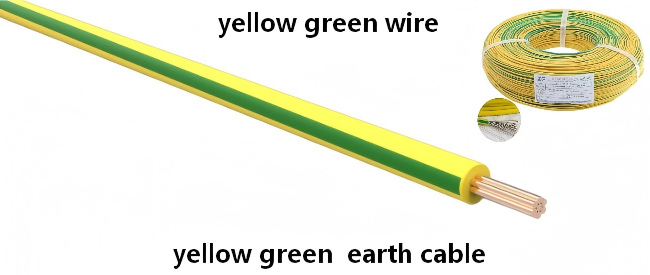
In household circuits, industrial plants, and commercial building electrical systems, we often see yellow-green striped wires. Unlike live wires that transmit electrical energy, or neutral wires that form a circuit, they play a vital role in electrical safety, acting as a "lifeline." This specially colored wire is the protective Earth wire (PE wire), and its core purpose is to prevent leakage accidents and protect personal and equipment safety.
Yellow-green wires are internationally recognized protective earth wires (PE wires), specifically used to connect exposed conductive parts of electrical equipment to the earth, forming a safe discharge path. According to international standard IEC 60446 and Chinese national standard GB/T 5226.1-2019, yellow and green are the exclusive colors for grounding conductors and are strictly prohibited from being used on any other wires. This unified standard ensures rapid identification of grounding conductors globally, effectively preventing safety accidents caused by color confusion.
In terms of materials, the conductors of yellow-green striped wires are mostly copper or aluminum with high conductivity, while the insulation layer typically uses weather-resistant and corrosion-resistant materials such as PVC and TPE. In some special scenarios, double insulation is used to enhance the protection level. Their specifications range from 0.75mm² to 185mm², adaptable to the needs of electrical equipment with different power ratings and environments. It is important to note that the minimum cross-sectional area of a separately laid copper PE conductor should not be less than 2.5mm² when protected against mechanical damage, and not less than 4mm² when unprotected. Aluminum conductors must have a cross-sectional area of at least 16mm².
The core characteristics of yellow-green striped wires revolve around two main aspects: "safety identification" and "reliable conduction," which can be specifically divided into three points:
Exclusive color identification, extremely high recognizability: The combination of yellow and green colors provides a strong warning, allowing for quick differentiation of grounding cables from other conductors even in complex cable wiring environments. The initial design purpose was to reduce the risk of misoperation by colorblind professionals (approximately 7%-10% of men are red-green colorblind), thus strengthening safety from a visual perspective.
The material is highly adaptable and has excellent conductivity: the copper conductor version has extremely high conductivity, quickly dissipating fault current; the aluminum conductor version offers better cost-effectiveness and is suitable for large-scale installations. The insulation layer is temperature-resistant, moisture-proof, and abrasion-resistant, adaptable to working environments from -40℃ to 105℃, meeting the needs of various installation scenarios, including indoor, outdoor, and underground installations.
The standard is strictly enforced and cannot be substituted or misappropriated: both IEC standards and national standards clearly stipulate that yellow-green bicolor wires are only for grounding conductors and are prohibited from being used as live, neutral, or control wires. In my country's electrical engineering acceptance, this standard has a rigid constraint; improper wiring will directly lead to project failure.
The working principle of a grounding cable is essentially to provide a low-impedance discharge path for fault current, breaking the dangerous cycle of "electric shock caused by current." When electrical equipment leaks current due to insulation damage, aging, or other reasons, the current is conducted through the equipment's metal casing to the yellow-green grounding cable, and then through the grounding cable to the earth, thus achieving three core functions:
Strictly adhere to grounding system specifications: In a TN-C-S system, the PEN conductor (protective neutral conductor) must not be merged again after being separated into N and PE conductors; in a TN-S system, the N and PE conductors must be installed separately to prevent the PE conductor from carrying neutral current, which could lead to potential rise. It is strictly forbidden to use metal pipelines transporting flammable liquids or gases as grounding conductors to prevent corrosion and leakage that could cause secondary accidents.
Ensure proper construction quality control: Grounding cable connections must use reliable welding or dedicated joints to avoid incomplete or false welds; welded joints must be treated with anti-corrosion measures to prevent rust and breakage after long-term use. When buried underground, the grounding electrode depth must meet standards; avoid using sand, gravel, or construction waste as backfill soil to reduce the risk of corrosion.
Regular inspection and maintenance: Regularly measure the grounding resistance to ensure that the grounding resistance of the AC working ground and safety protective ground is ≤4Ω, and the combined grounding system is ≤1Ω. Pay special attention to checking the corrosion of grounding cable joints and welded joints; replace aged or damaged insulation layers promptly to prevent grounding failure. Enhanced Protection in Special Scenarios: In flammable and explosive environments, additional electrostatic protection grounding is required; for intelligent systems, the copper cross-section of the separately installed grounding wire should not be less than 25mm². Aluminum conductors must not be used as buried grounding electrodes or connecting conductors to prevent grounding interruption due to electrochemical corrosion.
To improve the working efficiency and long-term reliability of grounding cables, three aspects need to be addressed: materials, processes, and system design.
In material selection, prioritize highly conductive and corrosion-resistant materials. Copper conductors have a much higher conductivity than aluminum conductors and superior corrosion resistance, making them suitable for scenarios with high reliability requirements. If aluminum conductors are chosen for cost-effectiveness, the cross-section needs to be increased and proper anti-corrosion treatment should be applied. Composite processes such as galvanizing and tin plating, or conductive anti-corrosion coatings, can be used to slow down conductor corrosion.
In construction processes, optimize connection and laying methods. Use low-impedance connection methods such as crimping and welding to reduce contact resistance at joints; grounding cables should avoid being laid parallel to high-voltage cables and should be kept away from high-temperature, humid, and chemically corrosive areas. For underground cables, cathodic protection or anti-corrosion coating can be used to resist soil electrochemical corrosion.
In system design, a reasonable grounding grid should be constructed. A shared grounding device should be used to ensure that the grounding resistance meets the minimum requirements for various grounding types; the connecting conductors between the main grounding terminal and the grounding electrode should not be less than two, and they should be connected to different points on the grounding grid to form redundant protection. Simultaneously, equipotential bonding should be used to eliminate potential differences between equipment and improve system stability.
Selection by scenario and power: For residential, office, and other civil scenarios, 2.5-4mm² copper PVC insulated yellow-green cables can be selected, suitable for leakage protection of ordinary household appliances; for industrial plants and large equipment, 10-185mm² coarse cross-section cables should be selected according to the fault current to ensure that the fault current can quickly trigger the protection device; the grounding wire of a separately set intelligent computer room should be made of ≥25mm² copper.
Selection based on environmental conditions: For damp environments such as outdoors and underground, choose double-insulated, weather-resistant TPE or cross-linked polyethylene insulated cables, and ensure proper waterproofing and corrosion protection. For high-temperature environments, use insulation materials with a temperature resistance of ≥90℃. For flammable and explosive environments, choose flame-retardant and anti-static grounding cables.
Selection based on standards and compatibility: Export equipment or overseas projects must comply with IEC 60446 standards, ensuring cable color and specifications meet the requirements of the target country. Domestic projects must strictly adhere to GB standards, prioritizing products with CCC certification. For temporary grounding scenarios, flexible bare copper or transparent PVC insulated cables can be used, balancing flexibility and visibility.
In grounding cable procurement, choosing a compliant and reliable supplier is a prerequisite for ensuring electrical safety. Guangdong Zhengfeng Wire&Cable Co., Ltd., with its solid qualifications and product strength, comprehensive pre-sales service and after-sales support, has become the preferred partner for many companies.
Tel/WhatsApp/WeChat: +86 138 2929 2517 / +86 147 4930 7879
Email: manager01@wire-cablemanufacturer.com


Products
Navigation
QR Code


Copyright © 2026 Guangdong Zhengfeng Wire&Cable Technology Co., Ltd.