 Zhengfeng
 Oct 22,2026

1.What Does AWG Specify in an Electronic Wire?
2.What Is the Difference Between Conductor Diameter and Wire Outer Diameter?
3.How Can Conductor Construction Affect Wire Diameter?
4.Why Does Insulation Thickness Affect Finished Outer Diameter?
5.Can Different Insulation Materials Have Different Outer Diameters?
6.Why Can the Same Wire Specification Have Dimensional Variation?
7.Why Does Finished Outer Diameter Matter in Electronic Products?
8.How Should Engineers Compare Wire Specifications?
9.What Should You Confirm Before Ordering Electronic Wire?
10.Why Choose Guangdong Zhengfeng Wire & Cable Co.,Ltd. for Your Wire Needs?
11.Frequently Asked Questions (FAQ)
When selecting electronic wire for a new product, engineers often begin with the American Wire Gauge (AWG) size. However, two wires with the same AWG rating may have different finished outer diameters.
This difference matters when wire must fit through a connector, pass through a narrow opening, or be routed inside a compact electronic device. Choosing a wire based on AWG alone may not provide enough information for dimensional planning.
The key is to understand what AWG specifies, how conductor construction and insulation affect the finished wire, and which dimensions should be confirmed before selecting or ordering a product.
AWG, or American Wire Gauge, is a standardized system used to identify conductor sizes. It is widely used in electronic wire specifications, including many UL Appliance Wiring Material (AWM) styles.
A lower AWG number generally indicates a larger nominal conductor size. For example, 18 AWG has a larger nominal conductor size than 24 AWG.
However, AWG does not describe the complete dimensions of an insulated wire. It does not, by itself, specify the insulation thickness or the finished outer diameter.
This distinction is important when comparing products such as UL1007, UL1015, or UL10064. Even when two products use the same AWG, their complete wire constructions may differ.
For dimensional planning, AWG is the starting point—not the final measurement.
These two dimensions describe different parts of a wire.
For a simple round conductor with uniform insulation, the approximate relationship is:
Finished OD ≈ conductor diameter + 2 × radial insulation thickness
This is a geometric approximation, not a substitute for a manufacturer's dimensional specification. Stranded conductor geometry, insulation shape, and manufacturing tolerances can affect actual measurements.
When reviewing a wire datasheet, make sure you are comparing the same type of dimension. A conductor-size value should not be compared directly with the finished outer diameter.
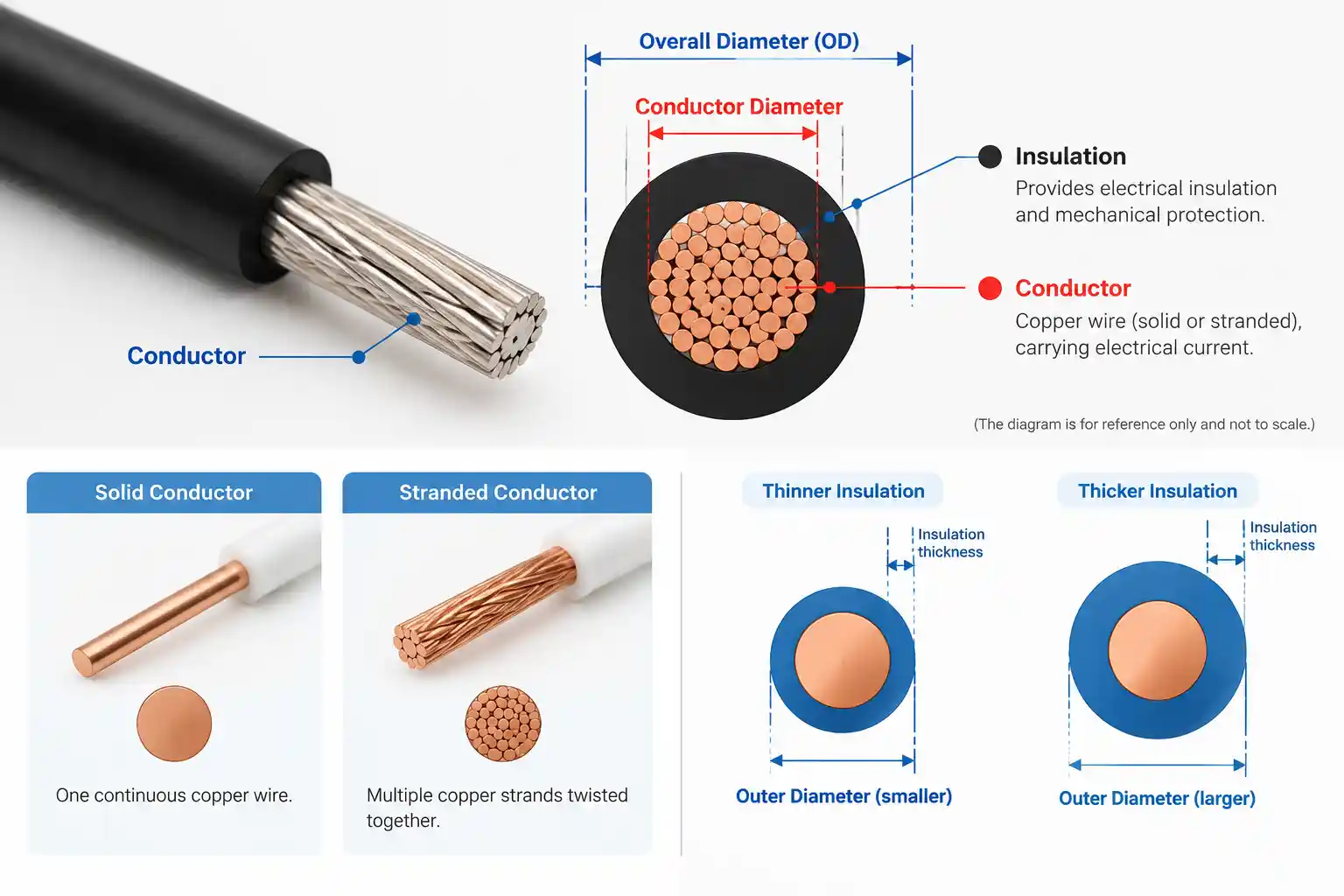
An electrical conductor can be solid or stranded, depending on the product design.
A solid conductor consists of one continuous metal wire. A stranded conductor consists of multiple smaller wires assembled into a conductor bundle.
A stranded-conductor specification may identify the strand count and the nominal diameter of each strand. These details help describe the conductor construction more precisely than AWG alone.
Two wires with the same nominal AWG may use different conductor constructions. The physical arrangement of the strands can affect the conductor bundle's geometry and the space it occupies beneath the insulation.
However, stranded wire does not automatically have a larger finished outer diameter than solid wire in every case. The actual result depends on the complete construction and the specified insulation dimensions.
When comparing two wires, check both the AWG and the conductor construction rather than assuming that the gauge alone determines the finished size.
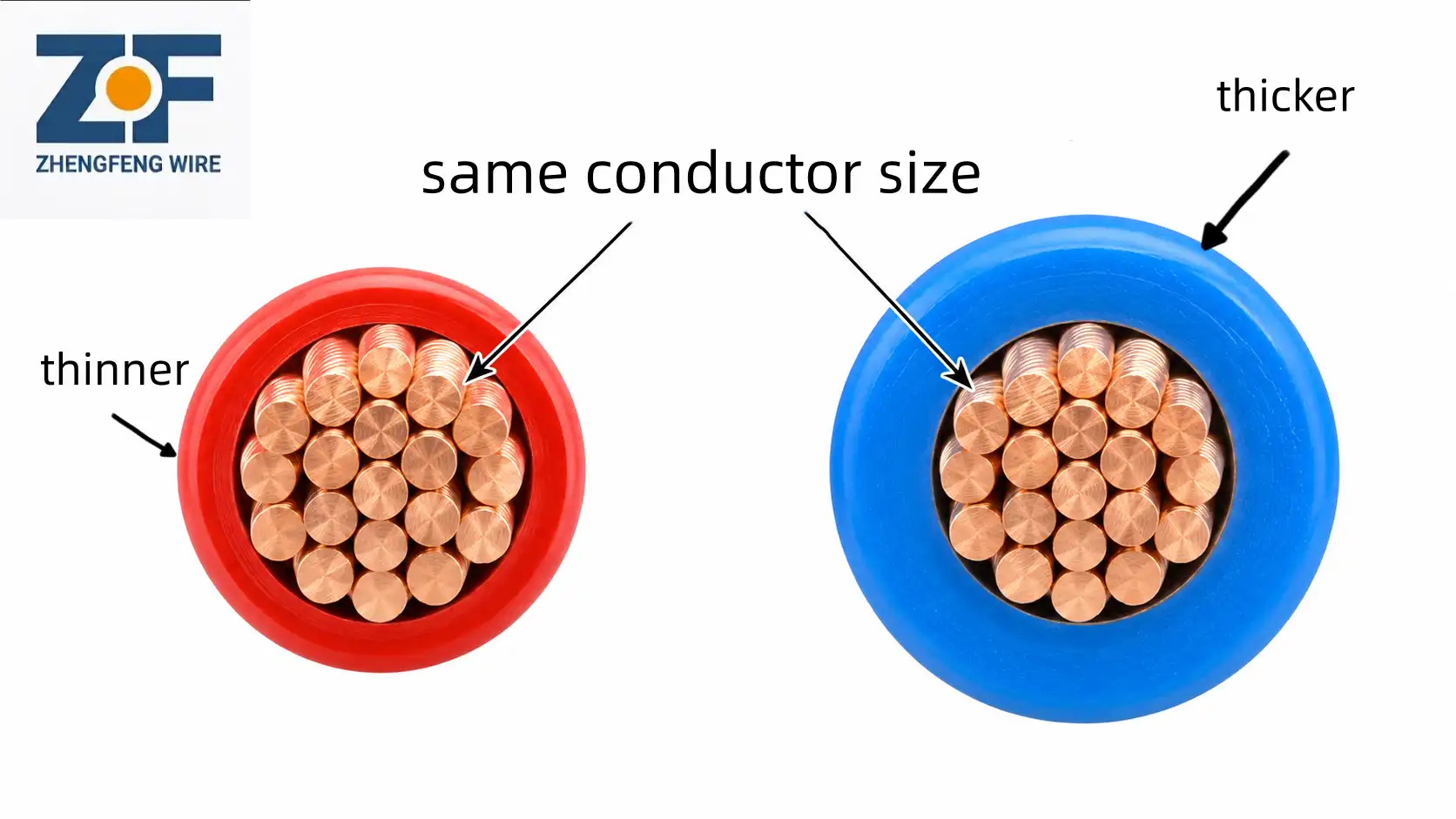
Insulation surrounds the conductor to provide the electrical and physical protection required by the wire design. Its thickness contributes directly to the finished outer diameter.
If two wires have comparable conductor dimensions but different specified insulation thicknesses, their finished outer diameters may differ.
For example, increasing the radial insulation thickness by 0.1 mm would increase the theoretical outer diameter by approximately 0.2 mm if all other dimensions remained unchanged.
This example illustrates the geometric relationship only. Actual wire dimensions must be confirmed using the relevant product specification.
Insulation thickness should not be evaluated in isolation. The required insulation design depends on the specific wire style, applicable requirements, material, and intended use.
A thinner insulation layer does not automatically make a wire more suitable. Engineers must confirm that the complete wire meets the required electrical, thermal, mechanical, and dimensional conditions.
Yes, but the material name alone does not determine the finished diameter.
Electronic wires may use PVC, silicone rubber, FEP, XLPE, or other insulation materials. These materials have different physical characteristics and processing requirements.
For example, UL1007 and UL1015 are PVC-insulated wire styles, while UL3135 is associated with silicone-insulated wire and UL10064 with FEP-insulated wire. The exact construction and ratings must be verified against the applicable product documentation.As buyers comparing UL1015 wire with other electronic wire types should review the applicable product specifications instead of assuming that the same AWG means the same finished outer diameter.
Products made from different materials may have different insulation designs and finished dimensions, even when their conductor gauge is the same.
When comparing wire options, engineers should evaluate the actual specified outer diameter alongside the material's suitability for the application. They should not assume that all wires made from one material share the same insulation thickness or that a particular material always produces a smaller wire.
A wire specification may state a nominal outer diameter or an acceptable dimensional range. Actual production measurements can vary within the applicable manufacturing tolerances.
Factors that may influence dimensions include the conductor construction, insulation extrusion process, tooling, and process control. The significance of each factor depends on the product and manufacturing conditions.
For engineering purposes, the key question is not whether every point along a wire is mathematically identical. It is whether the finished product meets its documented dimensional requirements.
If a design has strict space limitations, checking only a nominal diameter may be insufficient. Engineers should confirm the applicable tolerance and, when necessary, request dimensional inspection data from the manufacturer.
Specific tolerances should always come from the relevant product specification or agreed drawing, not from a general rule applied to every wire.
Finished outer diameter can affect how wire fits and is installed within an electronic product.
Space limitations: A wire that is larger than expected may not fit through a narrow opening or within a compact wiring channel.
Connector and terminal selection: The wire's conductor construction and overall dimensions must be compatible with the intended connection method. Outer diameter alone does not determine terminal compatibility.
Wire routing: When several wires share a limited space, their actual dimensions affect the room required for routing and assembly.
Production consistency: Confirming the wire construction and dimensional limits helps reduce uncertainty when approving samples and ordering production quantities.
These considerations are particularly relevant when engineers are comparing alternative wire specifications or developing products with limited internal space.
The goal is not simply to choose the smallest wire. It is to select a wire whose complete specification meets the application's requirements.
When comparing two electronic wires with the same AWG, use the same set of parameters for both products.
|
Parameter |
What to verify |
Why it matters |
|
AWG |
Nominal conductor gauge |
Establishes the conductor-size reference |
|
Conductor construction |
Solid or stranded; strand count and strand diameter where specified |
Clarifies the conductor configuration |
|
nsulation material |
PVC, silicone, FEP, XLPE, or another specified material |
Confirms material suitability |
|
Insulation thickness |
Nominal value and applicable requirements |
Nominal value and applicable requirements |
|
Finished outer diameter |
Nominal dimension and tolerance |
Supports installation-space checks |
|
Wire style and ratings |
Applicable UL style and required electrical or temperature ratings |
Helps confirm the correct product specification |
Compare the complete specifications rather than relying on a single field. If a particular dimension is critical to the design, state the requirement explicitly and ask the manufacturer to confirm it against the proposed construction.
When comparing wire options from different suppliers, ask for the relevant product specification sheets and confirm the finished outer diameter and applicable tolerances rather than relying on AWG alone.
Before requesting a quotation or approving a sample, engineers and purchasing teams should establish the technical requirements clearly.
Required AWG: Specify the intended conductor gauge.
Conductor construction: Confirm solid or stranded construction and the required details where applicable.
Insulation material: Identify the required material and applicable wire style.
Finished outer diameter: State the target dimension if the design has a size constraint.
Dimensional tolerance: Confirm the acceptable range rather than relying only on a nominal value.
Electrical and environmental requirements: Verify the required ratings and conditions of use.
Documentation: Request the relevant datasheet, drawing, or inspection information needed to approve the product.
If the proposed wire differs from the original design specification, review the difference before accepting a substitution. A matching AWG does not automatically mean that two wire products are interchangeable.
When comparing insulated wire options, buyers should check the conductor size, insulation thickness, and finished outer diameter of products such as UL1007 electronic wire.
Choosing electronic wire involves more than checking the AWG size. Buyers also need to consider conductor construction, insulation thickness, finished outer diameter, and the dimensional requirements of their applications.
Guangdong Zhengfeng Wire & Cable LCC. supplies a range of electronic wires and cables for different application requirements, including PVC, silicone rubber, FEP, and XLPE insulated wires.
Depending on the required wire type and specifications, buyers can explore products such as UL1007, UL1015, UL10064, UL3135, and UL3266. Each model has its own construction and performance characteristics, so the appropriate choice should be confirmed against the relevant product specifications.
When requesting a quotation, customers are encouraged to provide the required AWG size, insulation material, target outer diameter, voltage and temperature ratings, and application details. This information helps clarify the requirements before product selection and quotation.
If you are sourcing electronic wire for a new project or looking for a suitable alternative to your current wire, contact Guangdong Zhengfeng Wire & Cable Co. to discuss your requirements.


Products
Navigation
QR Code


Copyright © 2026 Guangdong Zhengfeng Wire&Cable Technology Co., Ltd.