 Zhengfeng
 Oct 23,2026

1.What Does Wire Insulation Thickness Actually Tell You?
2.Why Thicker Insulation Does Not Automatically Mean Better Quality
3.Why Minimum Insulation Thickness Matters
4.Insulation Uniformity: A Detail Buyers Should Not Ignore
5.Does Thicker Insulation Improve Electrical Safety?
6.How Insulation Thickness Affects Installation
7.Can Thicker Insulation Increase Purchasing Costs?
8.How Should Buyers Check Insulation Thickness?
9.When Should Buyers Consider Thicker Insulation?
10.Choosing the Right Wire with Guangdong Zhengfeng Wire&Cable Co., Ltd.
11.Frequently Asked Questions
When comparing electrical wires, buyers may assume that a thicker insulation layer provides better protection and higher quality. At first glance, this seems reasonable: more insulation should mean more protection, right?
However, wire quality cannot be judged by insulation thickness alone. A wire with thicker insulation is not necessarily safer, more durable, or better suited to a particular application.
The real question is whether the insulation meets the applicable requirements and performs reliably under the intended operating conditions. Understanding this distinction can help buyers make better purchasing decisions and avoid paying for specifications they do not actually need.
Wire insulation separates the conductor from its surroundings and helps prevent unintended electrical contact. Its thickness is an important design parameter, but it is only one part of the overall insulation system.
The required thickness depends on factors such as the wire construction, rated voltage, insulation material, applicable product standard, and intended application.
A thicker layer may provide additional physical protection in some situations. However, thickness alone cannot establish whether the material has suitable electrical, thermal, or mechanical properties.
For buyers, the first step is to understand the specified insulation thickness for the exact wire model rather than comparing finished-wire diameters alone.
Two wires may have different insulation thicknesses because they are designed for different purposes. One may prioritize compact dimensions, while another may require additional mechanical protection.
If both products meet their applicable requirements, the thicker wire is not automatically the better product.
Quality also depends on material consistency, conductor construction, manufacturing control, and compliance with the relevant specifications. A thick insulation layer cannot compensate for unsuitable material or poor manufacturing quality.
Buyers should therefore evaluate the complete wire specification instead of treating thickness as a universal quality indicator.
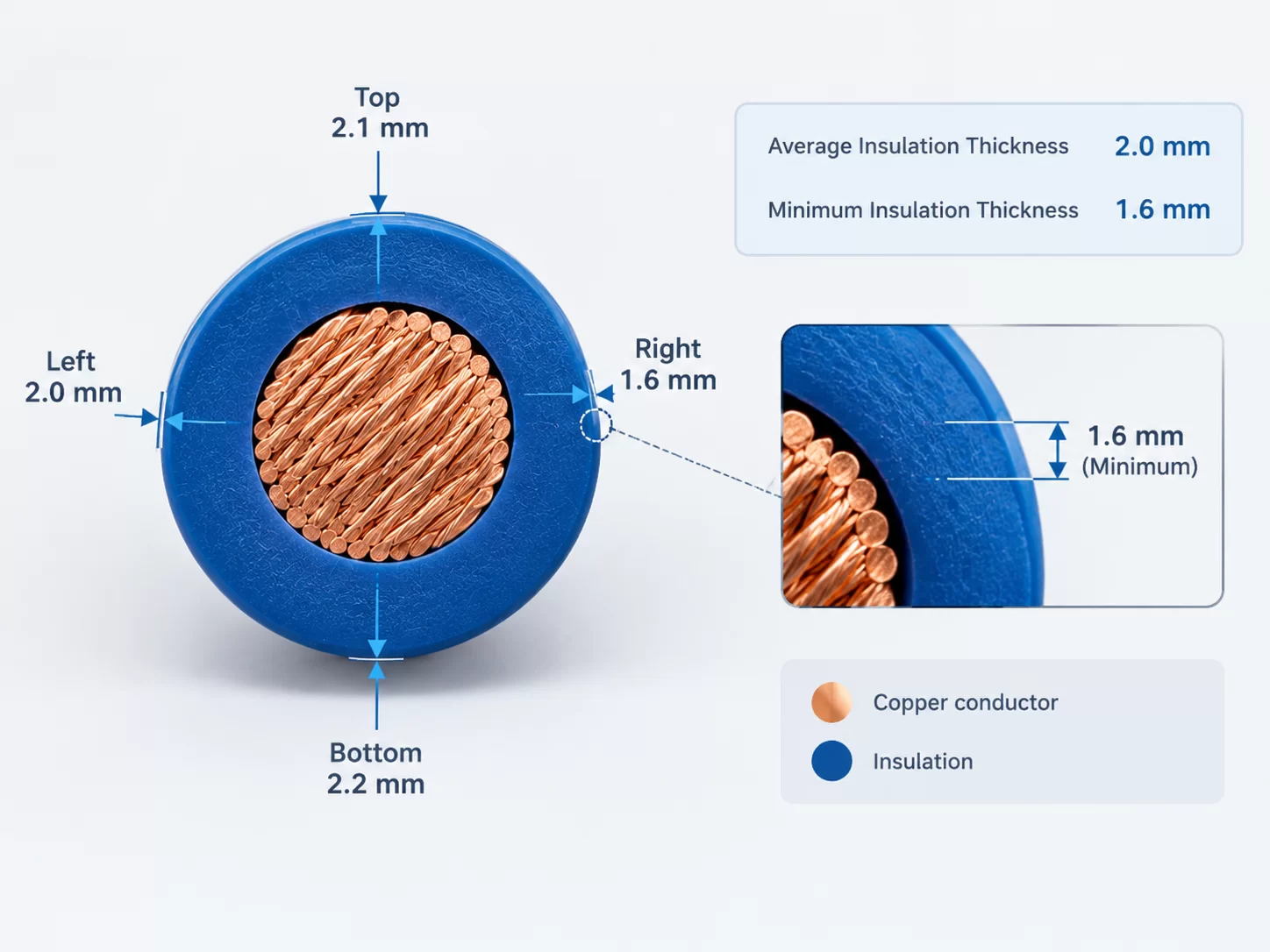
A wire's average insulation thickness does not necessarily reveal its thinnest point.
Many wire specifications distinguish between nominal or average thickness and minimum thickness. The applicable requirements depend on the particular wire type and standard.
Why does this matter? Electrical insulation must provide adequate protection throughout the conductor's circumference, not just at its thickest sections.
When evaluating a product, buyers should confirm the required average thickness and minimum thickness, where specified. A measurement that looks acceptable at one location does not necessarily establish compliance across the entire sample.
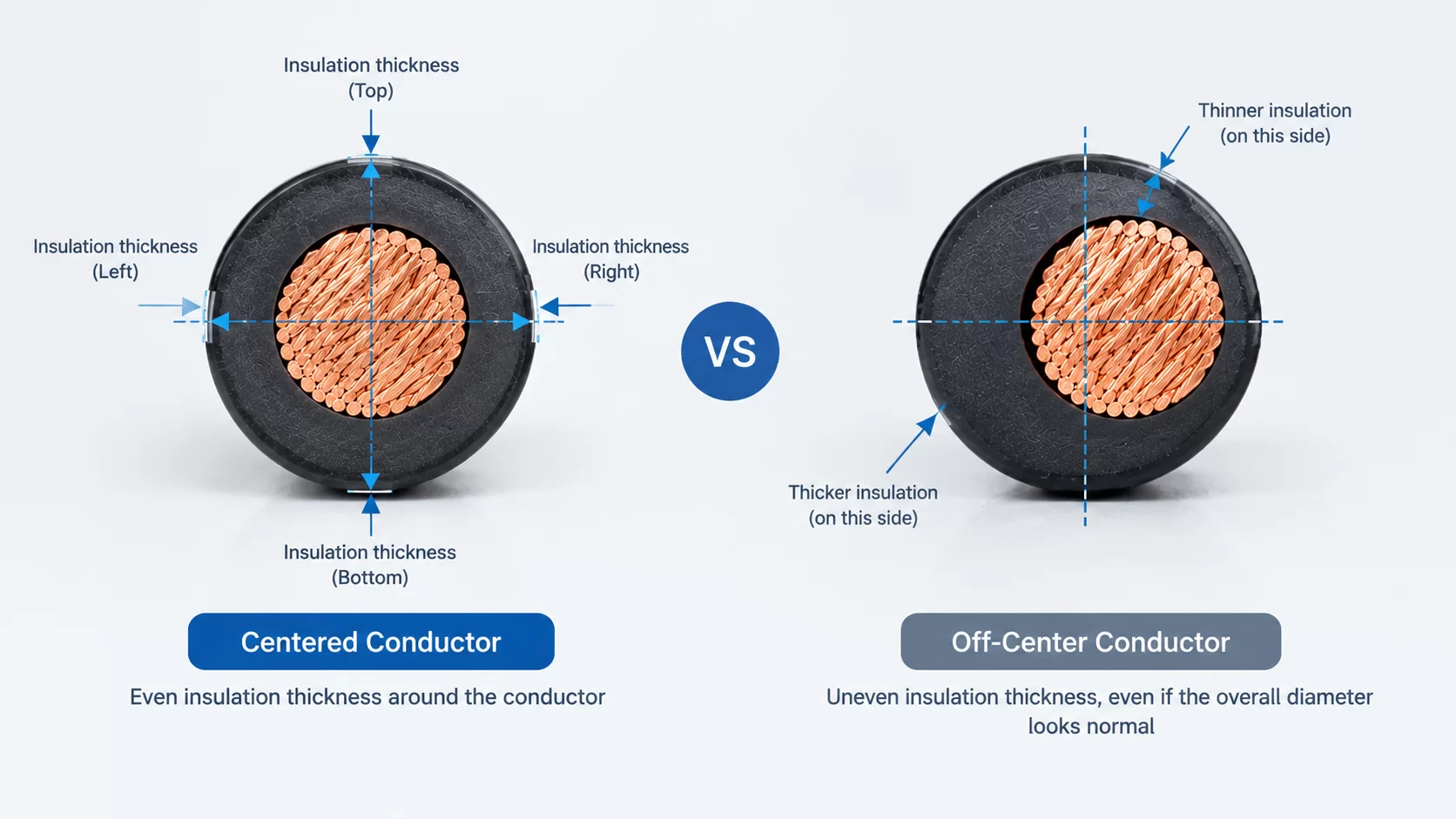
Insulation should be distributed appropriately around the conductor. If the conductor is positioned off-center, one side may have substantially thicker insulation than the other.
This condition is commonly associated with insulation eccentricity.
For example, a wire might have a relatively large outside diameter but still contain a locally thin insulation section. Measuring only the outside diameter would not reveal the complete picture.When insulation uniformity matters to an application, cross-sectional inspection and appropriate thickness measurements provide more useful information than appearance alone.
Additional insulation can provide benefits when a design requires greater electrical separation or protection. However, electrical safety depends on more than thickness.
The insulation material, rated voltage, dielectric performance, manufacturing consistency, and applicable testing requirements all matter.
A thicker layer made from an unsuitable material does not automatically provide better electrical performance. Likewise, a properly designed thin-wall wire can meet its intended requirements when manufactured and evaluated according to the applicable specification.Buyers should verify the wire's rated voltage and relevant compliance documentation instead of assuming that a thicker layer provides a higher voltage rating.
Thicker insulation generally increases the finished wire diameter when other construction parameters remain unchanged.
This can affect installation in compact electrical equipment, wire harnesses, connectors, terminal blocks, and applications where multiple wires must fit into limited space.
A larger diameter may also affect routing and handling. Depending on the wire construction and material, insulation geometry can influence bending and termination operations.
For this reason, buyers should consider the available installation space and connection requirements before requesting additional insulation thickness.
Additional insulation material may increase material consumption and affect finished-wire dimensions. Depending on the design and production process, it may also influence manufacturing costs and packaging efficiency.
However, thickness alone does not determine the final price. Conductor size, insulation material, temperature rating, certification requirements, production volume, and other specifications also contribute to cost.
Instead of asking suppliers to make insulation thicker without a clear reason, buyers should specify the required wire model, application conditions, and relevant technical requirements.
This approach makes quotations easier to compare and reduces the risk of paying for an unnecessary design change.
Before approving a wire sample or placing a bulk order, buyers can follow these steps:
Confirm the exact specification. Identify the wire type, conductor size, insulation material, rated voltage, and applicable standard.
Check the required thickness. Review the specified nominal or average thickness and any minimum-thickness requirement.
Measure the sample appropriately. Finished outside diameter can provide a preliminary reference, but it does not directly establish insulation thickness. Cross-sectional measurements may be necessary.
Evaluate uniformity. Where relevant, inspect whether the conductor is centered and whether insulation thickness varies excessively around the circumference.
Review supporting evidence. Request applicable inspection reports, dimensional records, and compliance documentation from the supplier.
The appropriate inspection method and acceptance criteria should follow the relevant product specification.
Additional insulation thickness may be appropriate when an application requires greater resistance to abrasion, handling damage, or other physical stresses, provided the wire design and applicable requirements support it.
However, buyers should first identify the actual problem they need to solve.
If the concern is high temperature, selecting a suitable temperature-rated insulation material may be more important than simply increasing thickness. If the concern is electrical performance, the complete wire rating and required tests must be considered. If the concern is mechanical damage, the buyer may need to evaluate the material's physical properties or consider a different protective construction.
The best specification is the one that addresses the real operating conditions without introducing unnecessary installation or cost disadvantages.
Choosing the right wire is not simply a matter of selecting the thickest insulation available. Buyers need to consider insulation thickness, material properties, conductor construction, temperature rating, and the requirements of the intended application.
At Guangdong Zhengfeng Wire&Cable Co., Ltd., we understand that different applications require different wire specifications. The right insulation thickness should match the product's applicable standards and operating conditions rather than being increased without a clear technical reason.
When sourcing electrical wires, buyers should pay attention to three important factors:
Insulation specifications: Confirm the required insulation thickness, dimensional tolerances, and finished-wire diameter according to the applicable product standard.
Material suitability: Select an insulation material that meets the application's temperature, electrical, and environmental requirements.
Quality verification: Review relevant product specifications, certification requirements, and inspection documentation to ensure the wire meets the agreed requirements.
Instead of judging wire quality by appearance alone, buyers should work with a supplier who understands the relationship between wire construction, insulation performance, and application requirements.
Whether you are sourcing silicone wires, PVC-insulated wires, or other electrical wires for your project, Guangdong Zhengfeng Wire&Cable Co., Ltd. can help you discuss the specifications relevant to your application and purchasing needs.
Looking for a suitable wire solution for your project? Contact Guangdong Zhengfeng Wire&Cable Co., Ltd. to discuss your required conductor size, insulation material, temperature rating, and applicable standards. Choosing the right specifications from the beginning can help you balance performance, installation requirements, and purchasing costs.


Products
Navigation
QR Code


Copyright © 2026 Guangdong Zhengfeng Wire&Cable Technology Co., Ltd.