 Zhengfeng
 Oct 30,2026

1.What Is Electrical Resistance in Wire?
2.Why Does Conductor Resistance Matter?
3.How Does Conductor Cross-Sectional Area Affect Resistance?
4.Does Stranded Wire Have Different Resistance from Solid Wire?
5.How Can Copper Material Affect Resistance?
6.Why Does Temperature Change Wire Resistance?
7.Why Can Resistance Measurements Differ Between Wire Rolls?
8.How Do Manufacturers Test Conductor Resistance?
9.What Should Buyers Check in a Wire Resistance Test Report?
10.Conductor Quality Control at Guangdong Zhengfeng Wire&Cable Co., Ltd.
11.Frequently Asked Questions
Electrical resistance is an important parameter in wire manufacturing and quality inspection. When buyers order the same wire specification in multiple rolls, they generally expect consistent electrical performance. However, resistance readings may show small differences between rolls or production batches.
These variations can come from several factors, including conductor construction, wire length, copper material, temperature, and measurement conditions. Understanding these factors helps buyers evaluate test results more accurately and identify whether a difference is within the acceptable product requirements.
Electrical resistance describes how strongly a conductor opposes the flow of electric current. It is commonly measured in ohms (Ω). In wire specifications, resistance is often expressed per unit length, such as ohms per kilometer (Ω/km), so different wire lengths can be compared on a consistent basis.
For copper wire, resistance is mainly influenced by the conductor material, cross-sectional area, length, and temperature. A longer conductor generally has higher total resistance, while a larger cross-sectional area generally results in lower resistance when other conditions remain the same.
This is why wire resistance cannot be evaluated by appearance alone. Two wires with similar outside diameters may have different conductor structures and electrical resistance.
Conductor resistance directly affects how electricity is transmitted through a wire. When current flows through a conductor, resistance contributes to voltage drop and power loss. Some electrical energy is converted into heat, which can affect the operating conditions of the wire and connected equipment.
For equipment manufacturers, resistance is an important consideration when selecting wires for internal connections, control systems, lighting products, and electrical assemblies. If conductor resistance is higher than the specified limit, the wire may not meet the electrical requirements of the intended application.
Therefore, resistance testing is not simply a routine inspection step. It helps verify whether the conductor meets the required electrical performance specifications.
The cross-sectional area of a conductor has a direct influence on its resistance. When the material, length, and temperature are comparable, a conductor with a larger cross-sectional area generally has lower resistance because it provides more space for current to flow.
AWG is commonly used to identify wire conductor sizes. One important detail is that a larger AWG number represents a smaller conductor diameter. For example, 24 AWG wire has a larger nominal conductor diameter than 30 AWG wire.
For stranded conductors, the total cross-sectional area depends on the number of strands and the diameter of each individual strand. Therefore, confirming the conductor construction is important when evaluating resistance.
A wire's AWG designation should be considered together with its approved conductor structure and applicable resistance requirements.
Different conductor constructions can affect the actual cross-sectional area and electrical resistance of a wire. Buyers comparing stranded copper wire should confirm the conductor material, strand count, and individual strand diameter before making a selection.
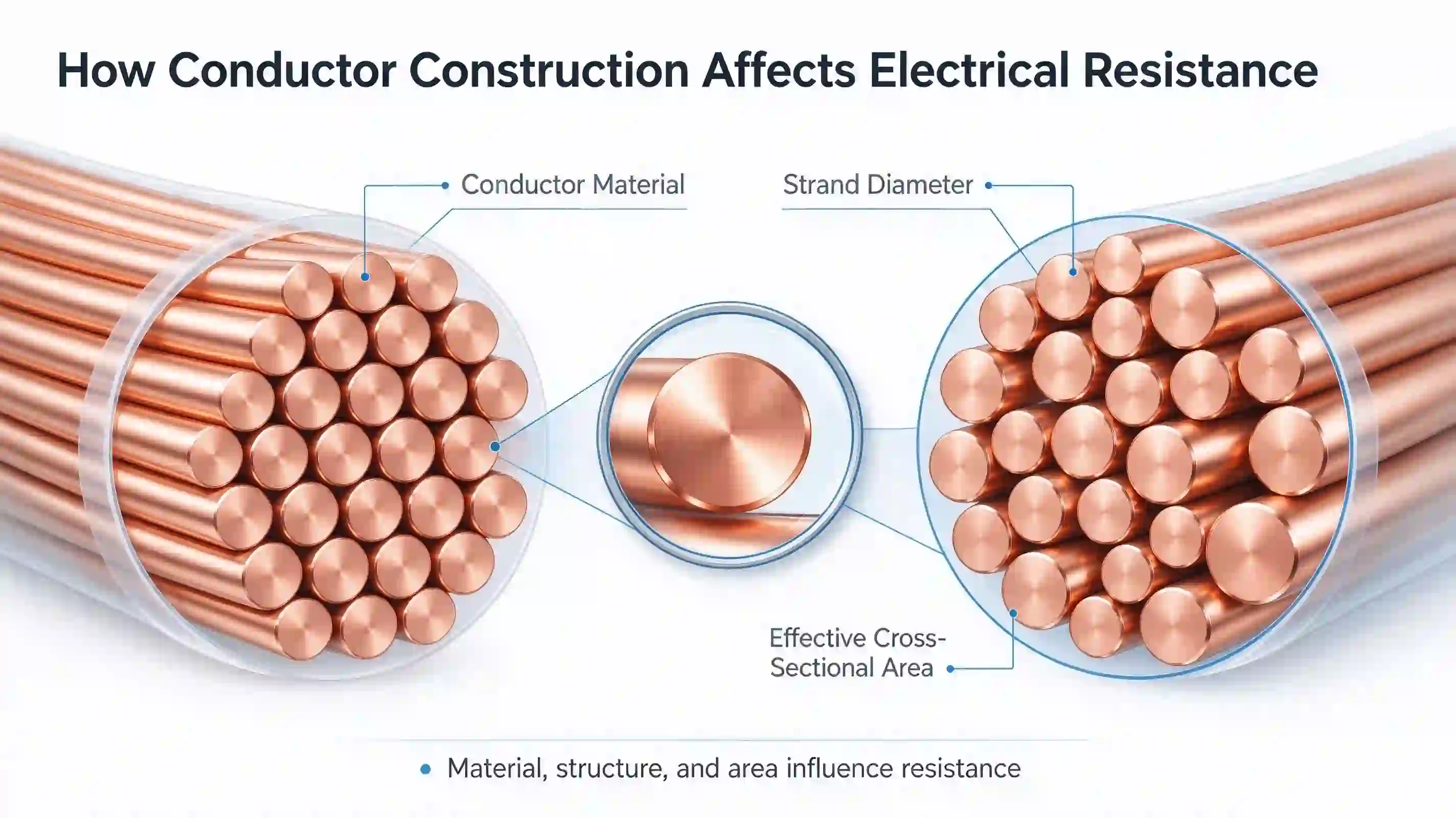
Solid and stranded conductors have different physical constructions. A solid conductor consists of one continuous metal wire, while a stranded conductor is made from multiple smaller wires twisted together.
In stranded wire, individual strands follow a slightly helical path rather than running perfectly straight along the finished wire. This means the actual conductor path can be longer than the overall cable length. Strand count, individual strand diameter, and the overall construction may therefore influence the resistance value.
However, it is not accurate to assume that every stranded wire has significantly higher resistance than every solid wire of the same nominal size. The actual result depends on conductor dimensions, material, construction, and the applicable standard.
When comparing solid and stranded wires, buyers should check the specified conductor construction and maximum resistance requirements rather than relying on the conductor type alone.
Copper is widely used in electrical wires because of its good electrical conductivity. However, the material and consistency of the conductor can influence its electrical properties.
Bare copper and tinned copper are two common conductor options. Bare copper has no additional metallic coating, while tinned copper has a thin layer of tin on the surface. Tinning is commonly used to improve surface protection and solderability.
It does not automatically mean that tinned copper has lower electrical resistance than bare copper. The resistance of the conductor depends primarily on the copper material, its effective cross-sectional area, and its construction.
For consistent electrical performance, manufacturers need to control conductor specifications and ensure that the selected material meets the requirements of the finished wire.
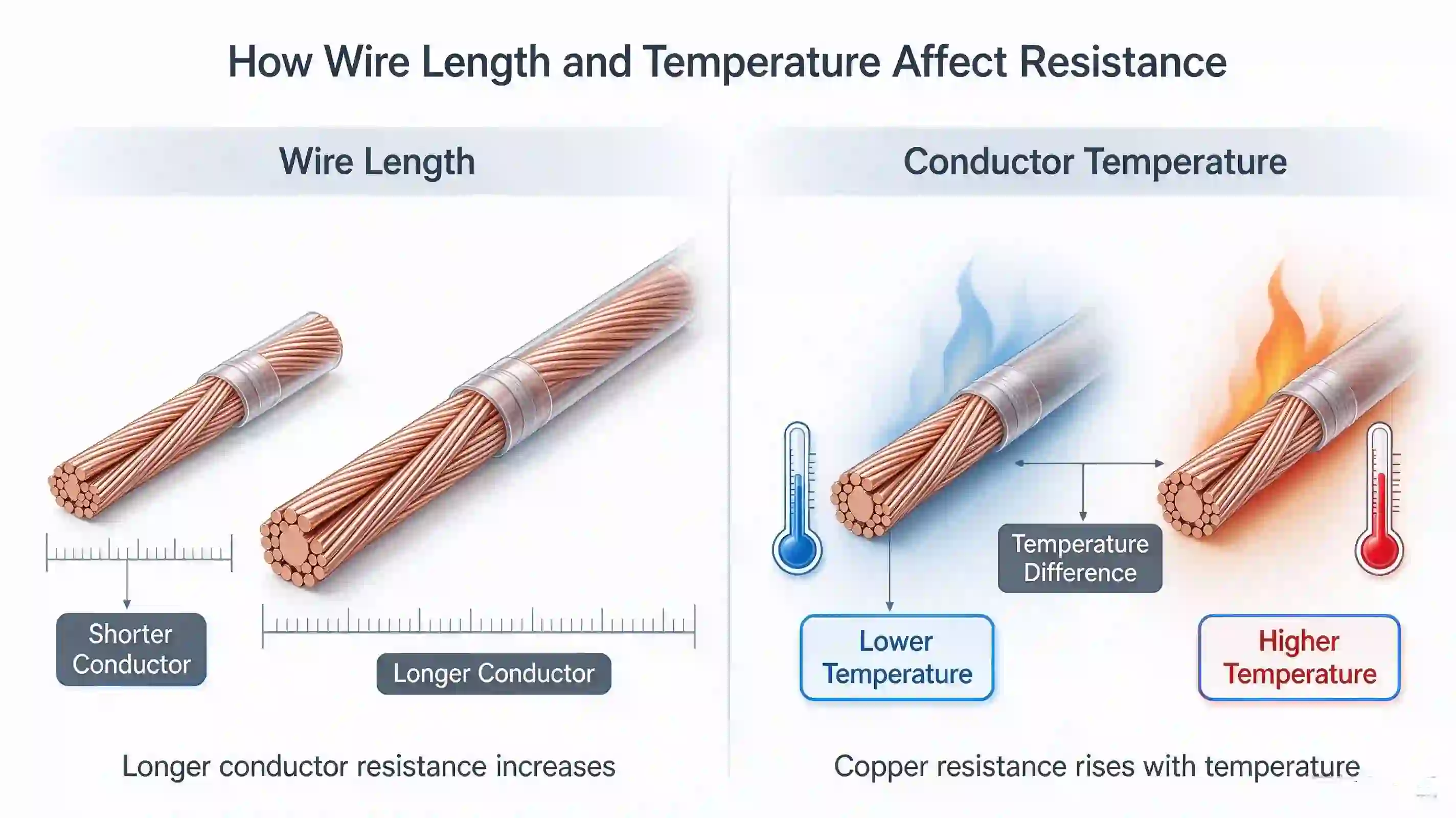
Temperature is another important factor when measuring conductor resistance. Copper resistance generally increases as temperature rises. This means the same wire can produce different resistance readings when measured at different temperatures.
For example, a wire measured in a warm production environment may show a different resistance value from the same wire measured in a cooler laboratory.
This is particularly important when buyers compare test reports from different suppliers or production batches. Without considering the measurement temperature, the readings may not be directly comparable.
Depending on the applicable standard, resistance measurements may need to be corrected to a specified reference temperature. The rated operating temperature of a wire should also be distinguished from the actual temperature during resistance testing.
When several rolls of the same wire specification show different resistance readings, the difference does not automatically indicate a manufacturing defect. Several factors should be considered.
Differences in conductor construction
The number of strands, individual strand diameter, and total conductor cross-sectional area can influence resistance. If the conductor construction varies from the approved specification, the electrical results may also change.
Differences in wire length
Total resistance increases with conductor length. A longer sample will naturally have higher resistance than a shorter sample made with the same conductor. This is why resistance values should be compared using the same reference length or converted to a standard unit such as Ω/km.
Differences in measurement temperature
Temperature changes can affect copper resistance. Measurements taken under different temperature conditions may produce different readings even when the wire construction is identical.
Measurement and contact errors
Loose connections, unsuitable test contacts, and instrument accuracy can affect measurement results. Consistent testing procedures and suitable equipment help reduce these errors.
Production batch differences
Changes in raw materials or conductor processing may influence the final electrical properties. Manufacturers should maintain appropriate production controls and inspection records to identify unexpected variations.
When resistance differences occur, the first step should be to confirm that the test conditions are comparable. The results can then be evaluated against the applicable product specification.
Manufacturers use suitable electrical testing instruments to measure conductor resistance. The testing process needs to account for sample length, electrical connections, temperature, and instrument accuracy.
A typical testing process includes preparing a sample with a known length, connecting the conductor securely to the measuring instrument, recording the resistance value, and evaluating the result against the applicable requirements.
Temperature correction may also be necessary depending on the test standard. For this reason, recording the measurement conditions is important when maintaining reliable inspection records.
Resistance testing is generally one part of a broader wire quality inspection process. Other checks may include conductor dimensions, insulation thickness, finished outer diameter, and voltage withstand performance, depending on the product requirements.
Consistent production processes and appropriate electrical testing help manufacturers maintain product quality. Explore our UL certified wire and cable range to learn more about the wire solutions available from Guangdong Zhengfeng Wire&Cable Co., Ltd.
A resistance test report provides useful information about whether a wire meets its specified electrical requirements. However, buyers should look beyond the measured value itself.
First, confirm that the product model, AWG size, conductor material, and conductor construction match the purchase specification. A resistance value cannot be evaluated correctly if the tested product does not have the expected construction.
Next, check the resistance value and its unit. Values expressed in Ω/km should not be directly compared with total resistance values measured over different sample lengths.
Buyers should also check the reference temperature or correction method where applicable, as well as the relevant product standard and maximum permitted resistance.
If different rolls show unusual variations, it is reasonable to ask the supplier to review the conductor specifications, test conditions, and inspection records.
Consistent comparison conditions make it easier to determine whether the results meet the required limits.
At Guangdong Zhengfeng Wire&Cable Co., Ltd., conductor specifications and electrical inspection are important considerations in wire manufacturing. Different wire models require different conductor constructions, materials, and electrical requirements.
Our product range includes PVC wires, silicone rubber wires, and XLPE wires for various electrical and equipment applications. Depending on the product specification, conductor construction and electrical testing requirements can be confirmed before production.
For projects where conductor resistance is important, buyers should provide the required wire model, AWG size, conductor material, strand construction, and applicable electrical standards.
Clear specifications and consistent inspection conditions help manufacturers and customers evaluate electrical performance and maintain product consistency.


Products
Navigation
QR Code


Copyright © 2026 Guangdong Zhengfeng Wire&Cable Technology Co., Ltd.