 Zhengfeng
 Oct 21,2026

1.What Does AWG Actually Tell You?
2.Same AWG Does Not Always Mean the Same Strand Construction
3.Insulation Is a Major Reason for Different Wire Diameters
4.Why Does Voltage Rating Affect Wire Construction?
5.Temperature Rating Can Also Change the Selection
6.Is a Thicker Wire Automatically Better?
7.Why Can Smaller Outside Diameter Be Useful?
8.Compare UL Style Before Comparing Diameter
9.PVC Electronic Wire Options from Guangdong Zhengfeng Wire & Cable Co.
10.How Should Buyers Compare Two Wires With the Same AWG?
11.Frequently Asked Questions
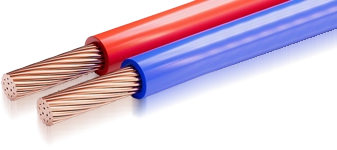
When purchasing electronic wire, buyers often assume that two wires with the same AWG size should have the same overall diameter. However, comparing two 20 AWG wires may reveal a noticeable difference in thickness.
Does this mean one wire contains less copper? Is the thicker wire automatically safer or better?
Not necessarily. AWG mainly relates to conductor size, while the finished wire diameter is influenced by conductor construction, insulation design, UL style, voltage rating, temperature rating, and application requirements. Understanding these differences can help buyers compare wire specifications more accurately.
AWG stands for American Wire Gauge, a system commonly used to describe conductor size. As the AWG number becomes smaller, the conductor becomes larger.
For example, 18 AWG has a larger conductor than 20 AWG, while 20 AWG is larger than 22 AWG.
The important point is that AWG should not be treated as the outside diameter of a finished insulated wire. Two wires can both be labeled 20 AWG while having different insulation constructions and therefore different finished outer diameters.
This distinction is particularly important when comparing different UL AWM styles.
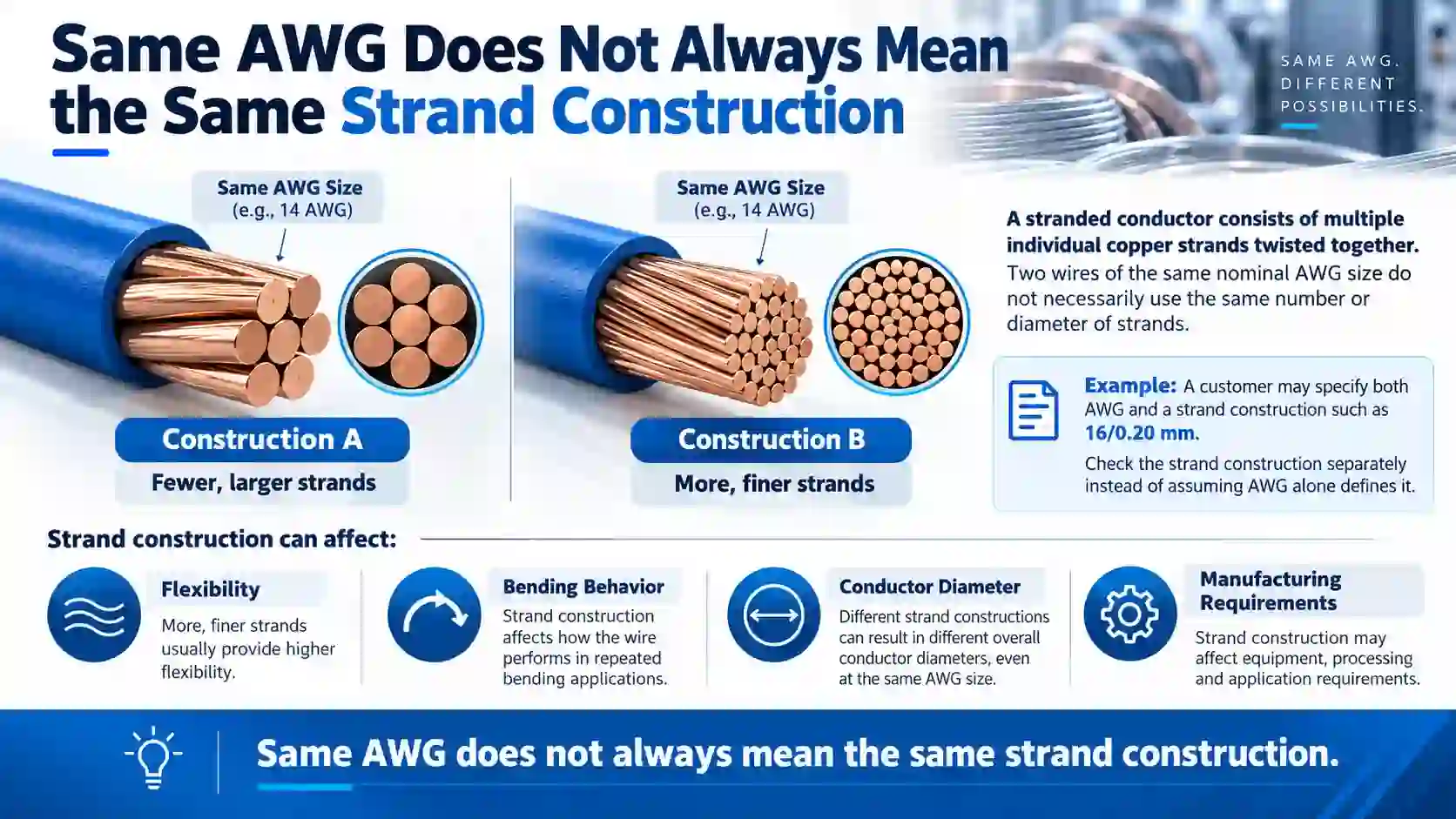
A stranded conductor consists of multiple individual copper strands twisted together. Two wires of the same nominal AWG size do not necessarily need to use exactly the same number or diameter of individual strands.
For example, one conductor may use fewer, relatively larger strands, while another construction may use more, finer strands.
The strand construction can affect characteristics such as flexibility, bending behavior, conductor diameter, and manufacturing requirements. Therefore, when a customer specifies both AWG and a construction such as 16/0.20 mm, the strand construction should be checked separately rather than assuming that AWG alone defines it.
After the conductor is manufactured, an insulation layer is extruded around it. This is one of the main reasons why wires with similar conductor sizes can have very different finished diameters.
Insulation is not simply added to make a wire look thicker. Its design is related to the electrical, mechanical, thermal, and construction requirements of the wire.
Different UL styles may specify different insulation constructions. As a result, even when two PVC wires use the same AWG conductor, their insulation thickness and finished OD can differ significantly.
Therefore: Same AWG ≠ Same Overall Diameter
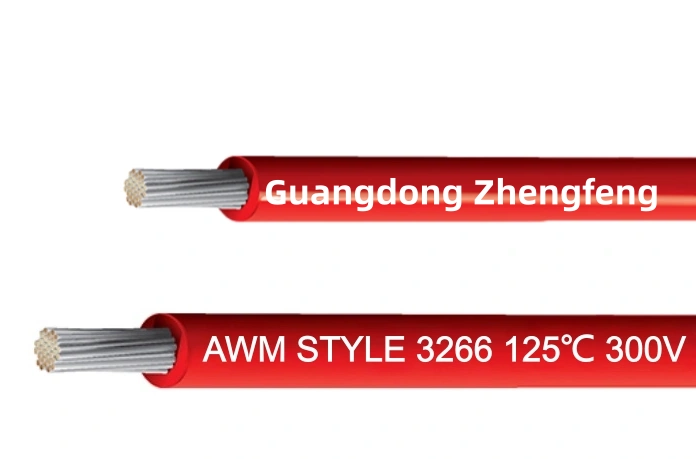
Voltage rating is another important factor to consider when comparing wires.
A wire designed for a particular voltage rating must use a construction that satisfies the applicable electrical and insulation requirements. This is one reason a 300 V PVC electronic wire and a 600 V PVC wire should not be compared only by AWG.
However, a higher voltage rating should not automatically be interpreted as “better quality.” A 600 V wire may simply be designed for a different application from a 300 V wire.
For buyers, the goal is not to choose the highest number, but to choose a wire whose rating matches the equipment and applicable requirements.
Temperature is another number buyers frequently encounter on wire specifications, such as 80°C or 105°C.
A higher temperature rating indicates that the wire is designed and evaluated for different operating conditions under its applicable requirements. It does not mean that every application should automatically use the highest-temperature wire available.
Insulation formulation, material performance, UL style, and intended use all need to be considered.
For example, one PVC electronic wire may be suitable for an 80°C application, while another PVC construction is designed for applications requiring a 105°C rating. The correct choice depends on the actual operating environment.
This is one of the easiest mistakes to make when comparing wire samples.
A buyer may place two wires side by side and assume:
Thicker wire = more material = better quality.
But overall diameter alone cannot determine wire quality.
A larger OD may result from a different insulation construction, voltage rating, conductor design, or UL style. Likewise, a smaller OD does not automatically mean that a manufacturer has reduced material improperly.
A properly designed wire should meet the construction and performance requirements applicable to its specification. For procurement, compliance and suitability matter more than simply choosing the thickest sample.
7. Why Can Smaller Outside Diameter Be Useful?
In many electronic devices, internal wiring space is limited. A smaller finished wire diameter can therefore provide practical advantages when the application and specification permit it.
Smaller wires may be easier to route through compact equipment, connectors, control systems, appliances, and densely wired assemblies. Reducing unnecessary bulk can also help engineers manage internal space more efficiently.
On the other hand, some applications require different insulation constructions or electrical ratings that naturally result in a larger OD.
This is why neither "thin" nor "thick" should be treated as universally better. The wire construction should match the application.
When buyers receive quotations from several wire manufacturers, comparing only AWG + price + OD can be misleading.
The UL style should also be checked because different styles can represent different construction and performance requirements.
For PVC electronic wire, buyers may encounter styles such as UL1007, UL1015, UL1569, and UL1571. Although all can use PVC insulation, they are not interchangeable simply because the conductor AWG is the same.
Before approving a wire, buyers should confirm the required UL style, conductor construction, temperature rating, voltage rating, finished OD, color, and any application-specific requirements.
Guangdong Zhengfeng Wire & Cable manufactures several PVC electronic wire series, including UL1007, UL1015, UL1569, and UL1571.
These styles allow buyers to select different PVC wire constructions according to their equipment and wiring requirements rather than relying on AWG alone.
PVC Wire SeriesKey Selection PointSuitable Selection Scenario
UL1007 General-purpose PVC electronic wireInternal wiring requiring a common PVC AWM construction
UL1569 Higher temperature rating than typical 80°C stylesEquipment requiring a 105°C-rated PVC wire option
UL1015 Higher voltage-rated PVC constructionApplications requiring a heavier-duty PVC electronic wire construction
UL1571 Compact PVC electronic wire constructionInternal electronic wiring where smaller finished dimensions may be important
Available AWG ranges, conductor constructions, colors, finished diameters, and other specifications should be confirmed according to the required product and application.
For customized orders, buyers can also provide their target conductor construction, OD, color, packing method, and other technical requirements for evaluation.
When two wires carry the same AWG marking but look different, do not judge them by thickness alone.
A better comparison starts with the complete specification:
AWG → Conductor Construction → UL Style → Insulation → Voltage Rating → Temperature Rating → Finished OD → Application
For example, if your drawing specifies 20 AWG together with a particular strand construction and maximum outside diameter, all of these requirements should be checked—not just the AWG number.
The most suitable wire is therefore not necessarily the thickest, thinnest, or highest-rated option. It is the construction that meets the electrical, mechanical, dimensional, certification, and application requirements of your equipment.
11.FAQ
The finished OD can vary because of insulation construction, strand design, UL style, and other specification requirements.
AWG primarily describes conductor size rather than the complete insulated wire diameter.
Yes. Stranded conductors can use different combinations of strand count and individual strand diameter.
No. More and finer strands can improve flexibility, but the appropriate construction depends on the application.
Not automatically. Safety and suitability depend on the complete wire specification and applicable requirements.
Its construction is designed for different electrical and insulation requirements, so finished dimensions can differ even at the same AWG.
No. A smaller OD can be intentional when the applicable wire construction permits a compact design.
Not automatically. Voltage, temperature, insulation construction, equipment requirements, and certification should be checked first.
Ideally provide UL style, AWG, conductor construction, color, required OD if applicable, quantity, packing requirements, and application information.
Choose according to the required electrical rating, temperature, dimensions, conductor construction, certification, and actual application rather than AWG alone.


Products
Navigation
QR Code


Copyright © 2026 Guangdong Zhengfeng Wire&Cable Technology Co., Ltd.