 Zhengfeng
 Oct 20,2026

Contents
1. Why Does New Silicone Wire Sometimes Smell?
2. Where Does the Smell of Silicone Wire Come From?
3. How Does the Curing Process Affect Silicone Wire Odor?
4. What Is Post-Curing and Can It Reduce Odor?
5. Why Does Silicone Wire Smell Stronger After Unpacking?
6. Does Strong Odor Mean Poor-Quality Silicone Wire?
7. Does Silicone Wire Odor Mean It Is Unsafe?
8. When Should Buyers Pay Attention to Silicone Wire Odor?
9. What Should Buyers Ask a Silicone Wire Supplier?
10.Silicone Wire Solutions from Guangdong Zhengfeng Wire & Cable Co.
11. Frequently Asked Questions
When opening a new package of silicone wire, some buyers may notice a distinctive smell. In some cases, the odor is mild and disappears quickly, while in others it may be more noticeable, especially immediately after unpacking.
This often raises an important purchasing question: Does a strong smell mean the silicone wire is poor quality?
Not necessarily. The odor of silicone wire can be influenced by several factors, including the silicone rubber formulation, curing system, processing conditions, post-curing, storage time, and packaging environment. Therefore, odor alone should not be used as the only indicator of wire quality.
Understanding where the smell comes from can help buyers distinguish between a normal manufacturing-related odor and a potential quality issue.
Silicone wire uses silicone rubber as an insulating material. However, the insulation is not simply made from one ingredient. A silicone compound may contain base polymers, fillers, pigments, curing agents, and other processing additives required to achieve specific physical and electrical properties.
During manufacturing and curing, small amounts of volatile substances may remain in or around the finished insulation. When freshly produced wire is immediately coiled and packed, these substances can become concentrated inside sealed bags or cartons.
As a result, the smell may be particularly noticeable when the package is first opened.
This does not automatically indicate defective insulation. The intensity and character of the odor should be considered together with the material formulation, production process, storage conditions, and actual performance of the wire.
Several factors can contribute to silicone wire odor.
One important factor is the silicone compound formulation. Different raw materials, fillers, pigments, curing agents, and processing additives can produce different odor characteristics.
Another factor is the curing system used during manufacturing. Silicone rubber must be cured to develop its final elastic and mechanical properties. Different curing systems and processing conditions can influence the amount and type of residual volatile substances in the finished insulation.
Production speed, curing temperature, curing time, ventilation, and the interval between production and packaging can also influence what a buyer smells after opening a package.
This explains why two silicone wires with similar dimensions and temperature ratings may not necessarily smell exactly the same.
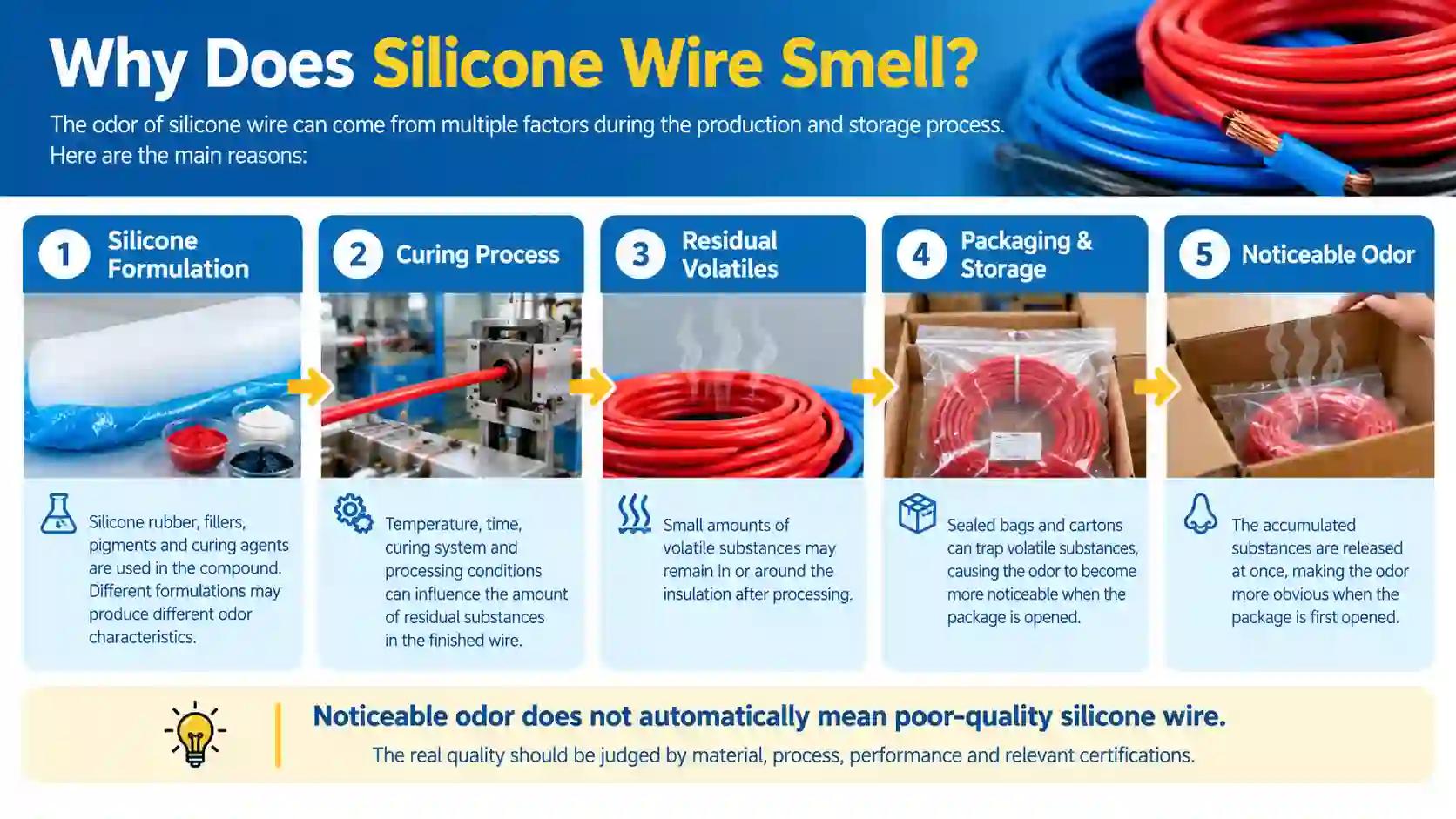
Curing is a critical stage in silicone wire manufacturing. After silicone insulation is extruded around the conductor, the material must undergo crosslinking to develop a stable elastomeric structure.
The effectiveness of this process depends on factors such as temperature, processing speed, curing time, material formulation, and equipment conditions.
If the processing conditions are different, the amount of residual volatile substances present after production may also differ. This can influence the initial odor of the finished wire.
Therefore, odor control is not simply a matter of choosing “good” or “bad” silicone. It can also reflect how the material is processed.
For professional buyers, understanding a supplier's curing process and process-control capability may provide more useful information than simply comparing samples by smell.
Some silicone products may undergo an additional heat-treatment process after initial curing, commonly referred to as post-curing.
Depending on the silicone formulation and application requirements, post-curing can help further stabilize the material and reduce certain residual volatile substances. As a result, it may also reduce noticeable odor in some silicone products.
However, post-curing should not be treated as a universal requirement for every silicone wire.
Whether it is necessary depends on the material system, manufacturing process, product specification, and final application. A wire should therefore not automatically be considered inferior simply because it has not undergone a particular post-curing process.
For applications with strict odor requirements, buyers should communicate these requirements with the manufacturer before mass production.
Packaging can make odor seem stronger than it actually is during normal use.
Imagine silicone wire being manufactured, wound into rolls, placed in plastic bags, packed into cartons, and then transported for several weeks. During this period, the wire remains in a relatively enclosed environment.
Even a relatively small amount of volatile material can accumulate inside the packaging.
When the bag or carton is opened, these accumulated substances are released at once, making the initial odor seem much stronger.
For this reason, evaluating odor immediately after opening a sealed package may not provide a complete picture. Buyers can also observe whether the odor decreases after the wire has been placed in a properly ventilated environment for an appropriate period.A strong smell immediately after unpacking does not automatically mean that the wire is defective.

This is the most important question for many buyers.The short answer is: not necessarily.
Odor is a sensory characteristic, while wire quality involves many measurable properties. A professional evaluation should consider factors such as conductor construction, insulation dimensions, electrical performance, mechanical properties, temperature rating, flame requirements, material consistency, and applicable certification or testing requirements.
However, this does not mean unusual odor should always be ignored.
If the smell is exceptionally strong or irritating, remains obvious after appropriate ventilation, varies significantly between production batches, or appears together with other abnormalities such as a sticky surface or unusual discoloration, further investigation may be appropriate.
Instead of immediately rejecting the product based on smell alone, buyers should ask the supplier for information about the material, curing process, production records, and relevant test documentation.
Another common misunderstanding is that a noticeable smell automatically means the wire contains harmful substances or fails environmental requirements.
Odor and environmental compliance are not the same thing.
Human smell is a sensory response to volatile substances. Compliance requirements such as RoHS or REACH, on the other hand, address specific restricted substances and regulatory requirements.
Therefore, a low-odor wire should not automatically be assumed to be environmentally compliant. Similarly, a noticeable odor alone is not sufficient evidence that a wire fails an environmental requirement.
If environmental compliance is important for an application, buyers should request appropriate documentation or test reports instead of relying on smell.
This distinction is especially important for international buyers sourcing wire for appliances, electronics, lighting equipment, and other products with specific compliance requirements.
Although some initial odor may be related to normal material and manufacturing factors, certain situations deserve additional attention.
Buyers should investigate further if the wire has an unusually sharp or irritating odor, if the smell remains very strong after ventilation, or if there are significant odor differences between supposedly identical production batches.
Odor becomes even more important when the wire is intended for an enclosed product.
For example, wires installed inside household appliances, lighting products, electronic devices, or other relatively enclosed equipment may influence the end user's experience if residual odor accumulates inside the finished product.
In these applications, odor may become an additional purchasing specification rather than simply a subjective observation.
If low odor is important, it is better to define the requirement during sample approval rather than after mass production.
When sourcing silicone wire, buyers should look beyond odor alone. The more important question is whether the supplier can provide a wire construction that matches the electrical, thermal, mechanical, and application requirements of the final product.
Before placing an order, buyers should confirm key specifications such as conductor size, conductor construction, insulation thickness, outer diameter, rated temperature and voltage, required color, flexibility, and applicable certification requirements.
For applications where odor is particularly important, such as enclosed electrical equipment, lighting products, household appliances, or electronic devices, buyers should also communicate this requirement during the sampling stage.
A reliable supplier should be able to help buyers evaluate the complete wire specification rather than simply claiming that a wire is "low odor" or "high quality."
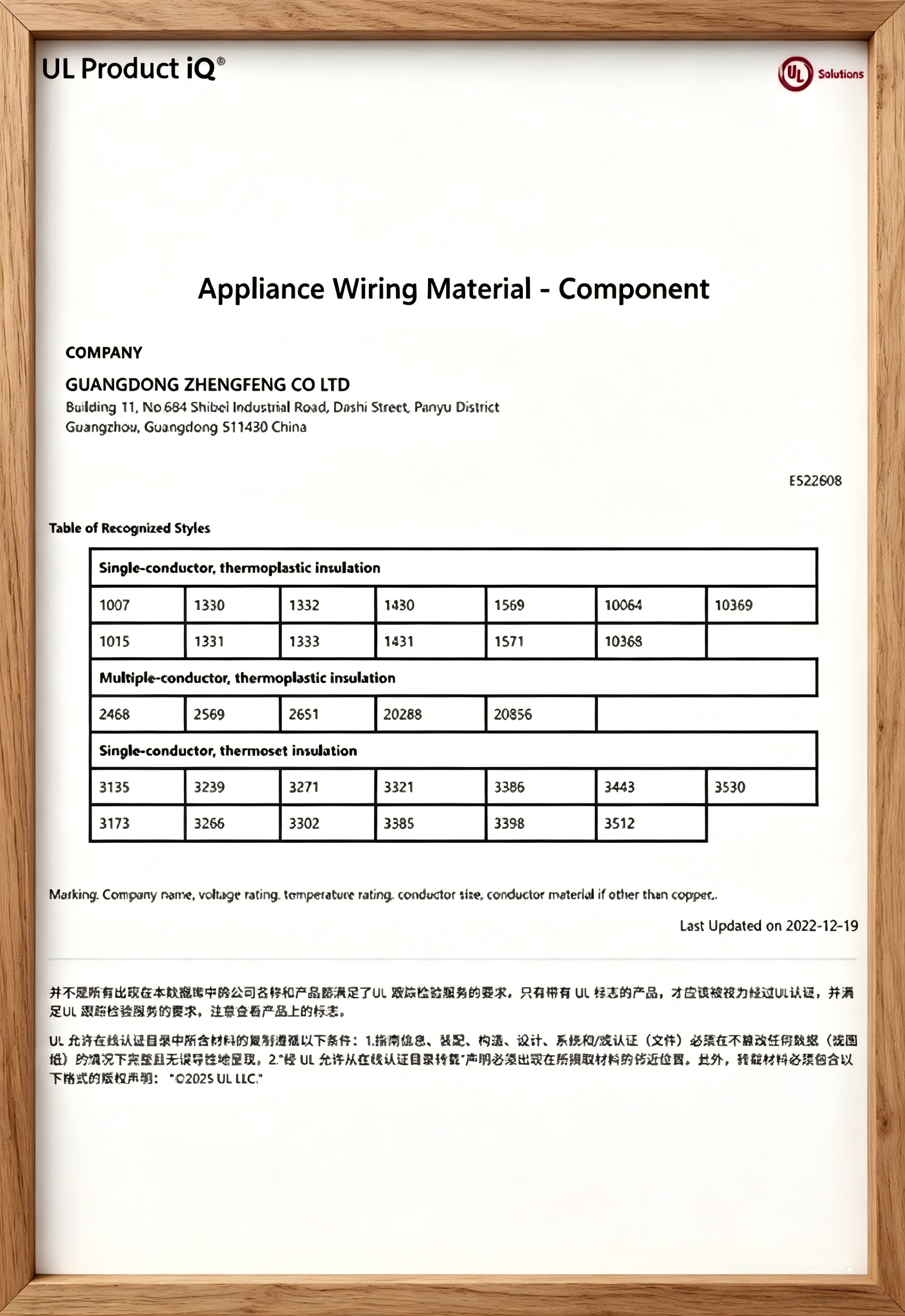
At Guangdong Zhengfeng Wire & Cable Co., we manufacture silicone insulated wires for a variety of electrical and electronic applications where flexibility and temperature resistance are important.Our silicone wire product range can be supplied in different conductor sizes, colors, conductor constructions, insulation dimensions, and other specifications according to product requirements.
Depending on the application and required standard, buyers can discuss with our team suitable silicone wire solutions for applications such as:
Household appliances – internal wiring for products exposed to elevated operating temperatures.
Lighting equipment – flexible internal connections for lamps and related electrical components.
Heating equipment – wiring applications where conventional PVC insulation may not provide the required temperature resistance.
Electrical and electronic equipment – internal connections requiring flexible silicone insulation.
Industrial equipment – wiring for equipment operating under higher-temperature or demanding conditions.
Customized wire applications – conductor size, color, dimensions, packaging, and other requirements can be discussed according to the project.
For customers sourcing silicone wire, we can communicate specifications before production and provide samples for evaluation when appropriate. If the final application has particular requirements regarding odor, flexibility, temperature resistance, dimensions, or compliance documentation, these should be identified during the inquiry and sample-confirmation stages.
This allows the wire to be evaluated according to the actual application requirements, rather than judging quality from odor alone.
| Zhengfeng Silicone Wire Range |
Product Type |
| UL3239 |
Silicone Rubber Wire |
| UL3135 |
Silicone Rubber Wire |
| UL3512 |
Silicone Rubber Wire |
| UL3530 |
Silicone Rubber Wire |
If you need a different UL style, conductor size, color, or wire construction, please contact us with your application and specification requirements.
If you would like to learn more about application solutions for silicone-insulated wires, please contact the sales team at Guangdong Zhengfeng Wire—China silicone wire manufacturer. We are available to assist you 24 hours a day.
Contact us
Guangdong Zhengfeng Wire&Cable Co., Ltd.
Tel/WhatsApp/Wechat: +86 13829292517
Tel/WhatsApp/Wechat: +86 14749307879
Email: manager01@wire-cablemanufacturer.com
Website: www.wire-cablemanufacturer.com


Products
Navigation
QR Code


Copyright © 2026 Guangdong Zhengfeng Wire&Cable Technology Co., Ltd.