 Zhengfeng
 Oct 19,2026

contact
1.Silicone Wire Is a Material Category, Not a Complete Specification
2.What Is a UL AWM Style Number?
3.Why Are There Different UL Styles for Silicone Wire?
4.What Can a UL Style Tell You About a Wire?
5.Same Silicone Material Does Not Mean the Same Wire
6.Why Does Zhengfeng Offer Multiple UL Silicone Wire Styles?
7.Why Shouldn't You Select Silicone Wire by UL Style Alone?
8. A Simple Example of Selecting a UL Silicone Wire
9.Common Mistakes When Buying UL Silicone Wire
10.What Information Should You Send to a Silicone Wire Manufacturer?
11.FAQ: UL Silicone Wire and AWM Style Numbers
Silicone rubber wire is widely used in electrical and electronic equipment where flexibility, temperature resistance, and reliable insulation are important. However, buyers searching for silicone wire often encounter product names such as UL3135 UL3239, UL3512, UL3530, and UL3122.
This can create a simple question: if these products all use silicone insulation, why do they have different UL Style numbers?
The term "silicone wire" mainly tells us what type of insulation material is used around the conductor. Silicone rubber is valued for properties such as flexibility and performance across a broad temperature range, making it suitable for many electrical applications.
However, insulation material alone does not fully describe a wire.
Two wires can both use silicone rubber insulation while having different conductor sizes, insulation thicknesses, voltage ratings, temperature ratings, or construction requirements. Their intended applications may also be different.
Therefore, simply asking a supplier for "silicone wire" usually does not provide enough information to identify the correct product.
A complete wire selection normally requires several additional conditions, such as conductor size, voltage, temperature, construction, UL requirements, and the intended application.
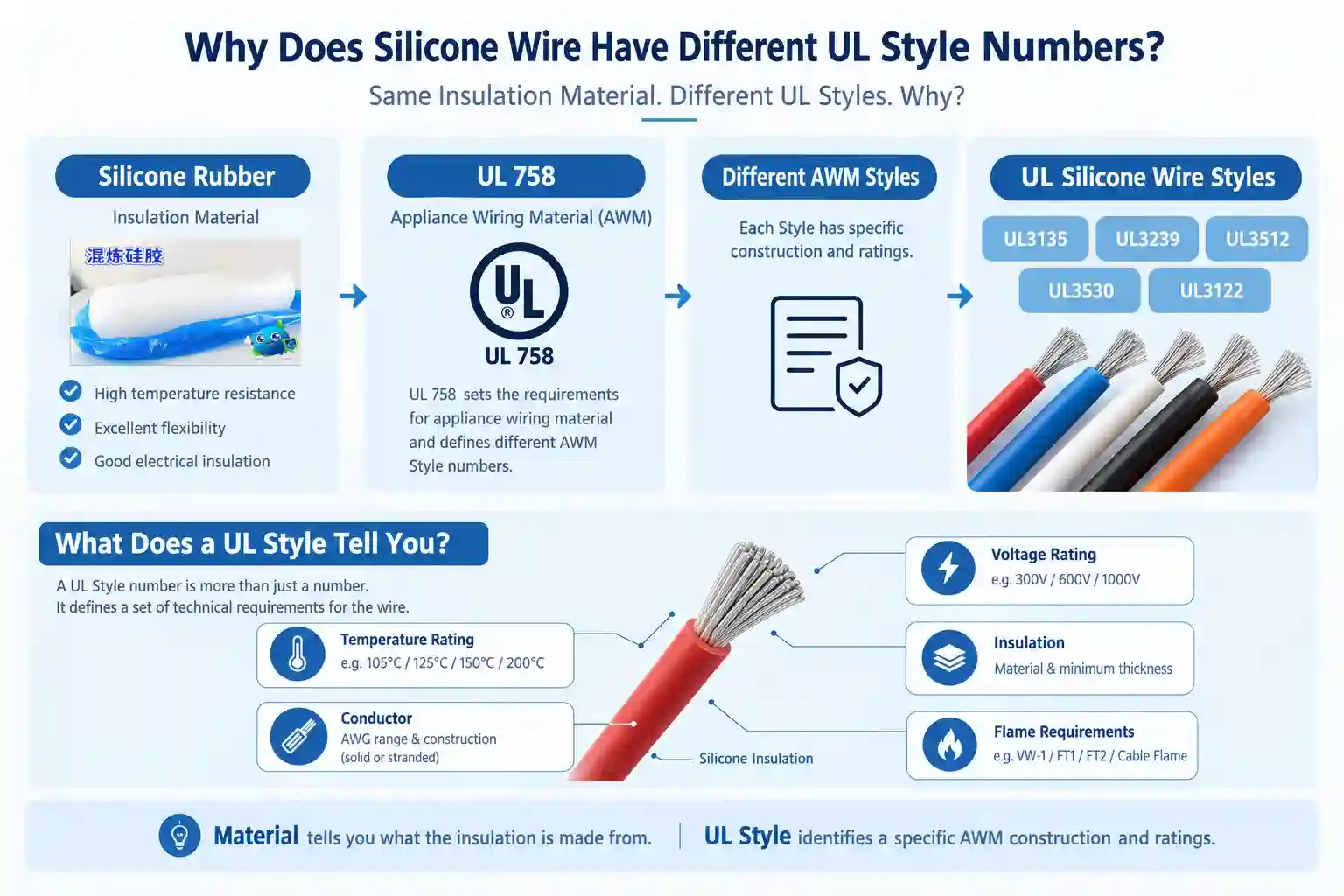
AWM stands for Appliance Wiring Material. UL 758 provides requirements covering appliance wiring material, while individual AWM constructions are identified by Style numbers.
This is why numbers such as UL3135, UL3239, and UL3512 should not simply be understood as different names for silicone rubber.
More precisely, numbers such as 3135 and 3239 are AWM Style designations. A Style establishes particular requirements associated with that wire construction, such as conductor parameters, insulation requirements, temperature rating, voltage rating, and other applicable conditions.
A useful way to understand the relationship is:
Silicone Rubber → Insulation Material
UL 758 → AWM Requirements
UL3135 / UL3239 / UL3512 → Different AWM Styles
This distinction is important when reading a specification sheet or comparing quotations from different
wire manufacturers.
Electrical equipment does not operate under one universal set of conditions. One product may require wiring for relatively high temperatures, while another may place greater emphasis on voltage capability or a particular wire construction.
As a result, one general "silicone wire" specification would not adequately represent every possible design.
Different UL AWM Styles allow specific constructions and ratings to be identified separately. This makes it easier for equipment manufacturers and wire buyers to determine whether a particular wire corresponds to their design requirements.
The different Style numbers should therefore not be interpreted as quality grades.
For example, a larger Style number does not automatically indicate better performance. UL3239 is not "higher grade" simply because 3239 is numerically greater than 3135. They are different Style designations intended to identify different constructions and requirements.
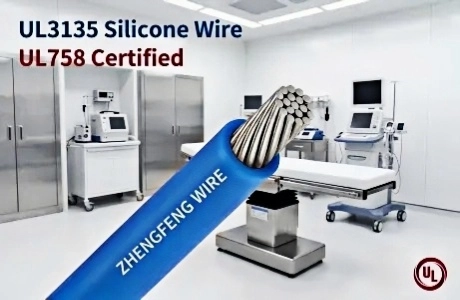
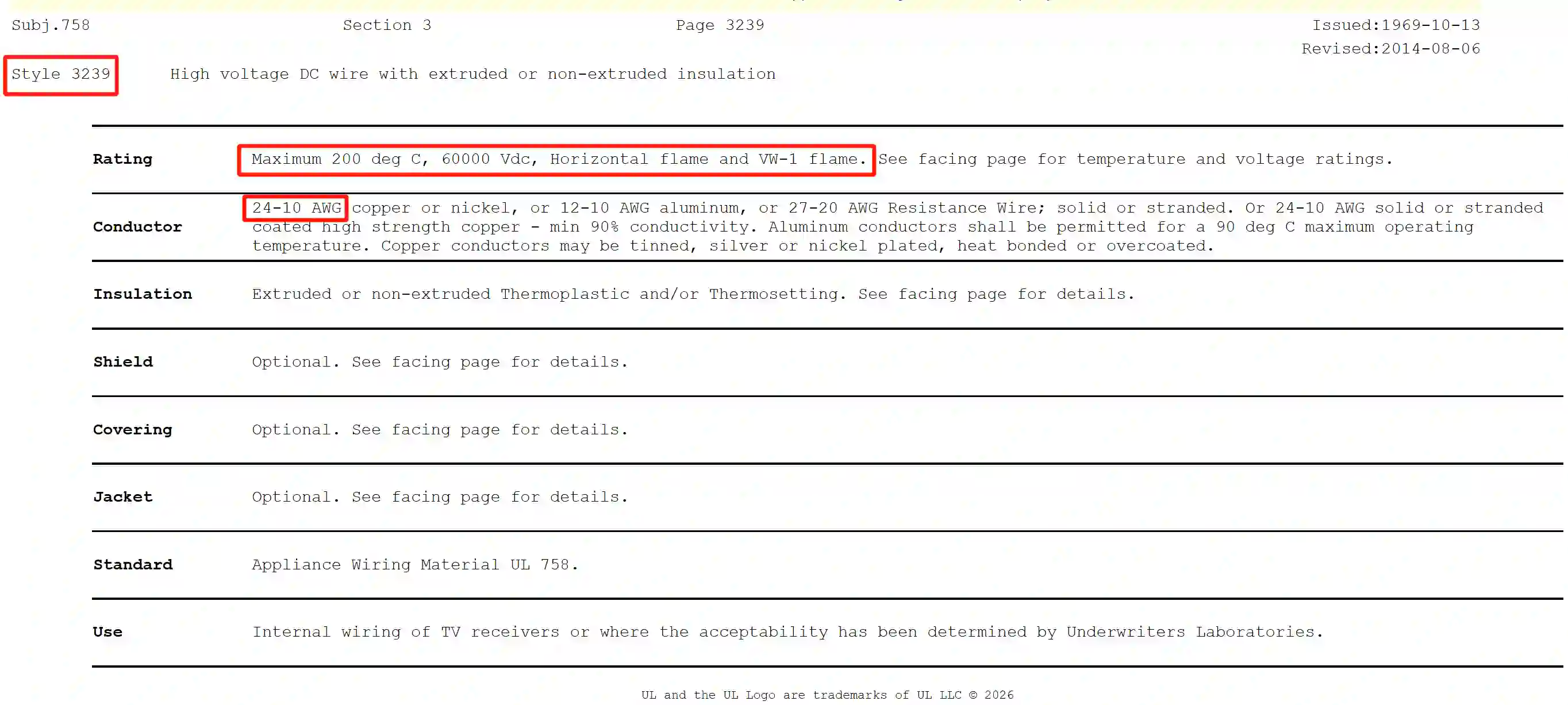
When buyers see a UL Style number, they should look beyond the number itself and examine the requirements associated with that Style.
Depending on the particular Style, important information can include the temperature rating, voltage rating, conductor range, insulation material, insulation thickness, and applicable flame requirements.
These characteristics help define the conditions for which that AWM construction has been evaluated.
For example, two silicone wires may look almost identical from the outside. However, if they belong to different AWM Styles, their rated voltage or insulation construction may differ.
This is why visual appearance is not a reliable method for determining whether two silicone wires are equivalent. The relevant Style information and the manufacturer's actual certified construction should be checked before making a substitution.
A common purchasing mistake is assuming that two wires made with silicone rubber should have approximately the same electrical and physical specifications.
Consider two products described simply as:
20 AWG Silicone Wire
At first glance, they appear to be the same product. But one may be manufactured to one AWM Style while the other follows another. Their voltage rating, temperature rating, insulation thickness, conductor construction, or finished outside diameter may therefore be different.
It helps to separate two questions:
Material tells you:
“What is the insulation made from?”
UL AWM Style tells you:
“What construction and ratings is this wire evaluated to?”
Neither piece of information should automatically replace the other. Buyers should use both when determining whether a wire matches the requirements of their equipment.
Guangdong Zhengfeng Wire offers several silicone rubber wire products, including UL3239, UL3135, UL3512, UL3530, and UL3122, as well as flexible and parallel silicone wire constructions.
The purpose of offering different products is not simply to provide multiple names for similar wires. Different applications can require different combinations of conductor size, temperature rating, voltage rating, insulation construction, flexibility, and dimensional requirements.
For this reason, buyers should avoid selecting a silicone wire only because a particular Style is popular or commonly used in another product.
The better approach is to begin with the electrical and mechanical requirements of the application and then determine which available UL Style and construction can satisfy those conditions.
For production orders, the manufacturer's current UL certification information and technical datasheet should be used to confirm the final specification.
Knowing the UL Style significantly narrows the selection, but it still does not provide every detail required for manufacturing or purchasing a wire.
For example, a buyer requesting UL3135 may still need to specify the required AWG size, conductor construction, insulation color, finished dimensions, quantity, printing, packaging, and other project-specific requirements.
Conductor construction can be particularly important when flexibility or termination methods matter. Similarly, finished outside diameter may be important when the wire must pass through a restricted opening or fit into an existing assembly.
Therefore, a UL Style should be treated as an important part of the specification rather than the entire purchase specification.
A clear inquiry combines the required Style with the actual construction and application requirements.
Suppose a buyer sends the following inquiry:“We need 20 AWG silicone wire.”
The manufacturer still cannot confidently determine the exact product because several important conditions are missing.
A more useful inquiry would include:
If the buyer already has an approved drawing or specified UL Style, that information should also be provided.
If the Style is unknown, providing the application conditions allows the wire manufacturer to identify suitable options for further technical confirmation.
One common mistake is specifying only "silicone wire" without providing electrical or construction requirements. Another is assuming that every silicone-insulated wire has the same temperature and voltage capabilities.
Buyers may also compare products only by AWG size. However, AWG primarily relates to conductor size and does not by itself define the complete wire construction. Insulation and finished dimensions still need to be considered.
Another misconception is treating UL Style numbers as a ranking system. A numerically larger Style number does not mean that the product is newer, safer, or better.
Finally, buyers should distinguish between a supplier describing a product as being similar to a UL construction and a product actually covered by the manufacturer's applicable UL certification.
Certification information should be verified when UL recognition is required by the project.
A detailed inquiry can greatly reduce unnecessary communication and help the manufacturer recommend or quote the correct wire.
Whenever possible, provide the following information:
If you do not know the exact UL Style, start with the conductor size, voltage, temperature, dimensional restrictions, and application.
The important principle is simple: choose the wire according to application requirements rather than choosing a Style number first and trying to make the application fit it.
A UL AWM Style number identifies a particular Appliance Wiring Material construction and its applicable requirements, rather than simply identifying silicone as an insulation material.
Not exactly. Silicone describes an insulation material, while UL3135 identifies a particular AWM Style. Not every silicone wire is UL3135.
They should not automatically be treated as interchangeable. Their applicable construction and ratings should be checked against the requirements of the equipment.
Q4. Does a higher UL Style number mean better wire?
No. Style numbers are identifiers rather than performance rankings. UL3239 is not automatically superior to UL3135 because its number is larger.
Q5. Can two silicone wires have different voltage ratings?
Yes. Silicone is the insulation material category, but different wire constructions and AWM Styles can have different electrical ratings.
Q6. Can two wires with the same AWG have different outside diameters?
Yes. AWG relates primarily to conductor size. Insulation construction and thickness can cause the finished outside diameter to differ.
Usually not. Buyers should also specify conductor size, construction, color, quantity, dimensions, packaging, and other project requirements where applicable.
Q8. Can I choose a UL Style based only on temperature?
Temperature is only one selection factor. Voltage, conductor size, construction, dimensions, application conditions, and equipment requirements may also need to be considered.
Buyers can request the manufacturer's UL file information and verify the relevant certification and product coverage through UL's official certification database.
Provide the manufacturer with your AWG or conductor size, required voltage and temperature, dimensional limits, application, and other technical requirements so suitable options can be identified.
The existence of multiple UL Style numbers for silicone wire becomes much easier to understand once material and wire specification are separated.
Silicone rubber describes the insulation material, while an AWM Style such as UL3135, UL3239, UL3512, UL3530, or UL3122 identifies a particular construction with defined requirements and ratings.
For buyers, the goal should therefore not be to find the "best" UL Style number. The goal is to identify the Style and construction that match the actual electrical, mechanical, dimensional, and application requirements.
Guangdong Zhengfeng Wire provides multiple UL silicone wire options for different equipment requirements. When requesting a quotation, providing detailed application and specification information can help us identify a suitable wire construction more efficiently.
Choose the application first. Then choose the wire that fits it.


Products
Navigation
QR Code

Copyright © 2026 Guangdong Zhengfeng Wire&Cable Technology Co., Ltd.