 Zhengfeng
 Aug 14,2026

When engineers and purchasing teams select wire for electrical equipment, the choice is rarely as simple as copper versus aluminum or one AWG size versus another. The insulation material can have an equally important impact on flexibility, temperature performance, installation space, service life, and overall system reliability.
Two of the most common insulation materials are silicone rubber and PVC (polyvinyl chloride). PVC wire remains an economical and practical choice for many conventional electrical applications. However, when a wire must remain soft, withstand repeated bending, tolerate elevated or low temperatures, or fit into compact and mechanically demanding assemblies, ultra flexible silicone wire can offer significant advantages.
But does that mean silicone wire is always better than PVC wire?---NO!
The technically correct answer is that silicone wire is better when the application requires properties that silicone insulation and fine-stranded conductor constructions are designed to provide. For cost-sensitive, relatively static applications operating within ordinary temperature conditions, PVC wire can still be the more appropriate solution.
This distinction is important for engineers and procurement professionals. Choosing wire solely because it is described as "soft," "high temperature," or "silicone" is not enough. The conductor material, strand construction, insulation thickness, AWG size, voltage rating, temperature rating, applicable UL Style, installation method, bending conditions, and environmental exposure all need to be considered.
This guide explains the engineering differences between ultra flexible silicone wire and PVC wire, why silicone wire is often preferred for demanding applications, and how to select the right construction for your equipment.
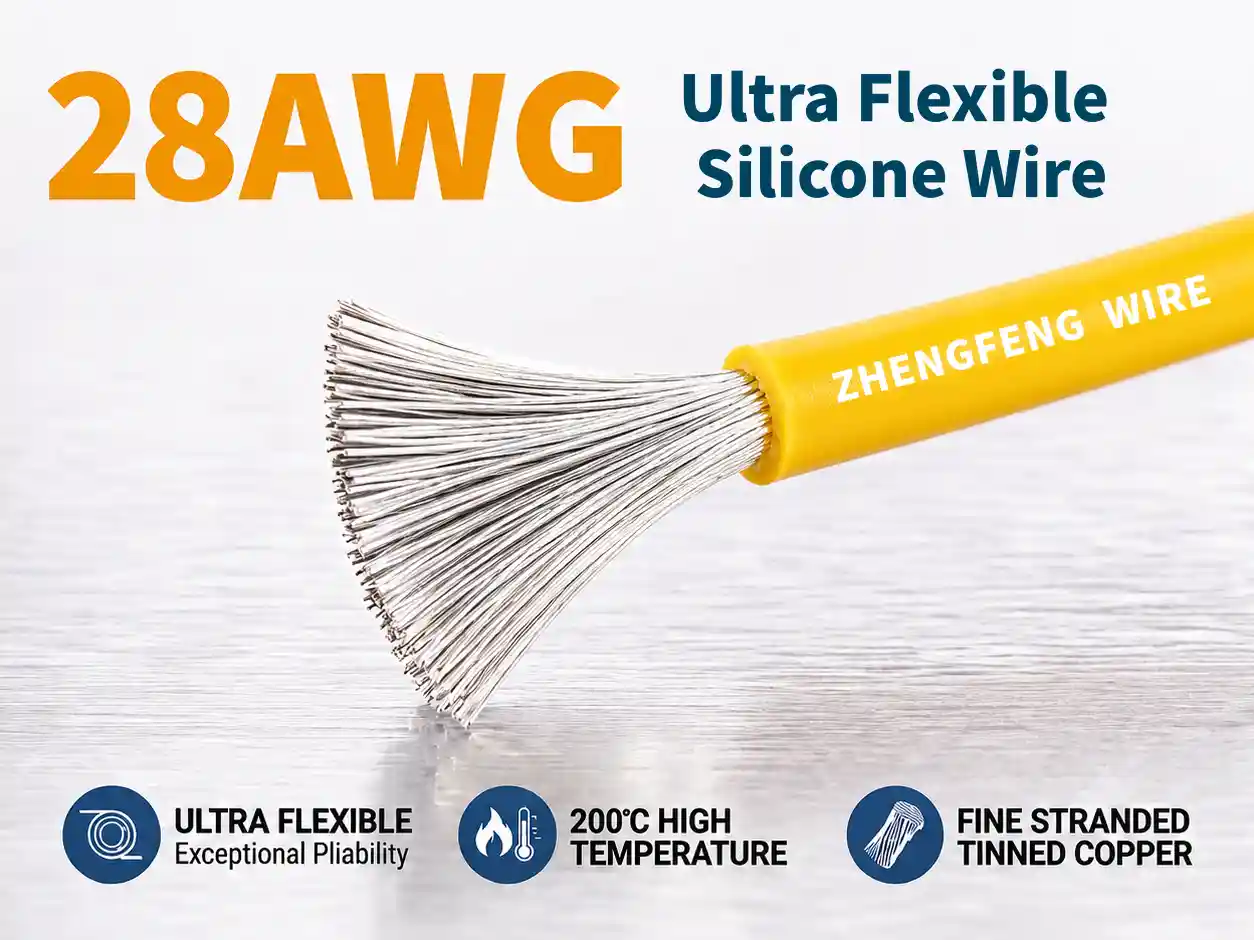
Ultra flexible silicone wire is an electrical wire that combines a highly flexible silicone rubber insulation system with a conductor construction designed for repeated bending and easy routing.
The word "ultra flexible" is not, by itself, a universal electrical standard or UL classification. It is a performance-oriented description. The actual flexibility of a wire depends on several variables, including:
A typical flexible silicone wire uses stranded copper rather than a solid conductor. Fine-stranded constructions can significantly reduce the mechanical resistance to bending because each individual copper strand can move relative to the others.
For example, a 12 AWG conductor may be manufactured with a relatively conventional strand construction or with a much finer-stranded construction. Both can have the same nominal electrical cross-sectional area, but their mechanical behavior can be noticeably different.
The fundamental difference is the insulation material.
PVC wire uses polyvinyl chloride as its primary insulation material. PVC is widely used because it offers a combination of electrical insulation, mechanical protection, manufacturability, chemical resistance, and relatively low cost.
Silicone wire uses silicone rubber insulation. Silicone elastomers are known for maintaining flexibility across a broad temperature range and for their resistance to several environmental stresses.
However, it is important not to compare silicone and PVC using one generic temperature number.
Different PVC compounds have different temperature ratings. Different silicone formulations also have different temperature ratings. The same applies to voltage ratings, flame performance, oil resistance, and mechanical properties.
For example, UL Style 3512 silicone-insulated wire is commonly available in constructions rated 600 V and up to 200°C, while other silicone wire constructions can have different ratings. UL Style 3239 is a high-voltage style, and its voltage rating depends on the specific construction and certification. Public UL 3239 product documentation shows constructions ranging from 3 kV DC upward, while other manufacturers offer different voltage configurations. Therefore, engineers should always verify the exact style and certification rather than assuming one universal rating for every silicone wire.
The same principle applies to PVC. There is no single "PVC wire temperature rating" that applies to every PVC wire. Therefore, the meaningful comparison is not:
Silicone = high temperature
PVC = low temperature
Instead, it is:
Which specific wire construction provides the required electrical, thermal, mechanical, and environmental performance for the application?
Flexibility comes from the interaction between the conductor and insulation system.
Many people assume that the silicone rubber itself is the only reason silicone wire is flexible. That is incomplete.
The conductor construction is equally important.
A solid copper conductor has a fundamentally different bending behavior from a finely stranded conductor. Even among stranded conductors, a wire made with fewer, larger strands can feel substantially stiffer than one made with many smaller strands.
For a simplified example, consider two wires with the same nominal AWG conductor size:
Wire A: relatively coarse stranded copper
Wire B: finely stranded copper
Wire B can generally tolerate tighter routing and repeated movement more easily because the individual strands accommodate bending.
The silicone insulation then contributes another important property: elastic flexibility.
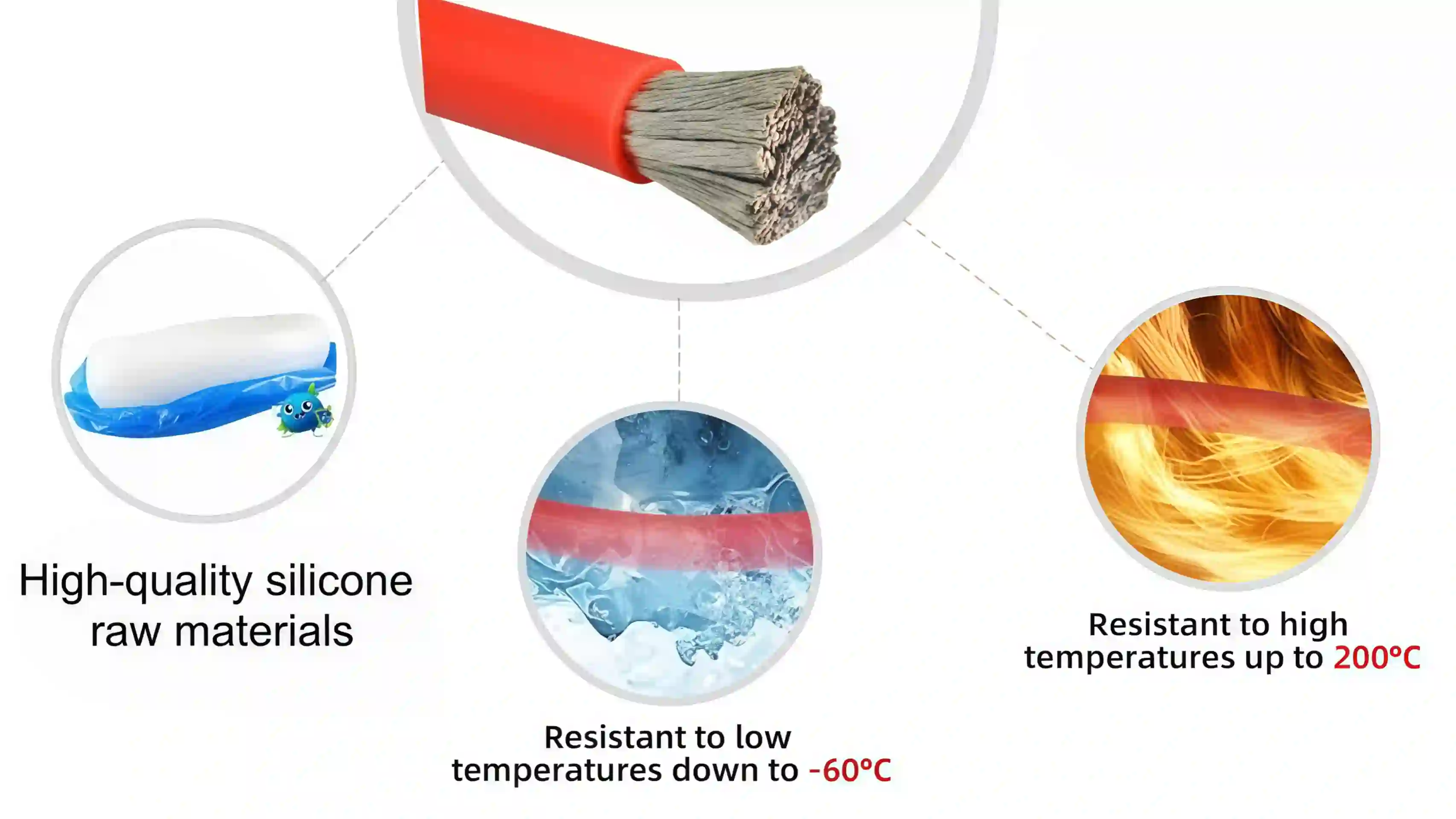
Silicone rubber can remain flexible over a broad temperature range. Some UL 3512 products, for example, are specified for operation from approximately -60°C to +200°C, although the exact range must always be verified against the manufacturer's certified construction.
This combination creates the characteristic feel associated with premium flexible silicone wire:
Fine-stranded conductor + elastic silicone insulation = high mechanical flexibility
This is particularly useful where the wire must be routed around corners, connected inside compact equipment, or repeatedly moved during operation.
For engineers designing flexible wiring systems, the number of strands is not merely a manufacturing detail.
It directly affects mechanical behavior.
A simplified example illustrates the concept:
Coarse-stranded conductor
A conductor consists of relatively few copper strands with larger individual diameters.
Advantages may include:
Lower manufacturing complexity
Good electrical performance
Lower cost
Potential disadvantages:
Higher bending stiffness
Less suitable for continuous dynamic movement
Larger mechanical force during tight routing
Fine-stranded conductor
A conductor consists of many smaller copper strands.
Advantages may include:
Better flexibility
Smaller bending force
Better suitability for repeated movement
Easier routing through compact assemblies
Therefore, when selecting specifications, we must choose the appropriate conductor structure based on the application scenario. The following conductors with diameters of 0.16mm, 0.254mm, and 0.08mm offer different effects.
One of the strongest reasons to select silicone insulation is temperature performance.
Silicone rubber can maintain useful flexibility at temperatures where many conventional insulation systems become significantly harder.
It is common to see silicone wire products specified for temperatures such as:150°C, 180°C, 200°C. But these numbers must not be treated as interchangeable.
For example, a product identified as UL 3512 may be rated 200°C and 600 V when manufactured to the applicable certified construction. Public product data from several manufacturers confirms UL 3512 constructions at 600 V and 200°C.
UL 3239 is different. It is associated with high-voltage lead-wire constructions, and the actual voltage and temperature ratings must be checked against the specific UL-recognized construction. One documented UL 3239 construction is specified at 150°C and 3 kV DC, while other UL 3239 constructions can have different voltage ratings.
Therefore, do not select wire based on the phrase "silicone 200°C" alone, we should verify:
This is particularly important for electrical equipment exported to North America, where engineers and buyers may require a specific UL AWM Style rather than simply a material description.Guangdong Zhengfeng Wire&Cable is a ul wires manufacturer that meets UL certification standards. We mass-produce silicone wires of various models and specifications and can provide application solutions for silicone wires.
PVC performance also depends heavily on formulation and construction.
In ordinary electrical applications, PVC can provide excellent value. It is widely used in appliances, control wiring, electronics, power cords, and general-purpose wiring.
However, when the operating environment moves toward the upper or lower limits of a particular PVC formulation, its mechanical behavior can change.
Depending on the formulation and temperature, PVC can become:
Softer at elevated temperatures
Harder at low temperatures
Less flexible after long-term thermal exposure
More susceptible to mechanical damage under unsuitable conditions
This does not mean that PVC wire is inherently unreliable.
It means that the temperature rating of the exact PVC wire must be matched to the application.
For a relatively static assembly operating within the wire's specified temperature range, PVC can be an excellent engineering choice.
For equipment involving continuous movement, repeated bending, elevated temperature, or severe temperature cycling, a properly selected silicone wire can provide a wider operating margin.
Another advantage of silicone insulation is its ability to maintain flexibility at low temperatures.
This matters in applications such as:
Battery systems
Outdoor equipment
Robotics
Automotive systems
Aerospace equipment
Portable instruments
Cold-environment machinery
A wire that becomes significantly stiffer at low temperature can impose greater mechanical loads on connectors, terminals, solder joints, and cable routing points.
Silicone insulation can remain comparatively flexible in cold environments. Some UL silicone products are specified down to approximately -60°C, depending on the formulation and certification.
However, the minimum temperature of the insulation is not necessarily the same as the complete cable system's dynamic rating.
Engineers should separately consider:
Conductor flexibility
Insulation flexibility
Connector temperature rating
Terminal temperature rating
Bending frequency
Bending radius
Mechanical stress
The weakest component determines the practical system limitation.
A practical comparison looks like this:
| Property | Ultra Flexible Silicone Wire | PVC Wire |
| Insulation | Silicone rubber | PVC |
| Typical flexibility | Very high with fine stranding | Low to moderate, construction-dependent |
| High-temperature capability | Often excellent;depends on UL Style | Highly dependent on PVC formulation |
| Low-temperature flexibility | Generally excellent | Highly formulation-dependent |
| Repeated bending | Good to excellent with suitable construction | Application-dependent |
| Compact routing | Excellent | Good to moderate |
| Aging resistance | Generally strong | Depends on formulation |
| UV/weather performance | Often good | Depends on formulation |
| Typical cost | Higher | Lower |
| Best use | Demanding thermal/mechanical applications |
General-purpose applications
|
The table should be interpreted as a general engineering comparison, not a certification specification.
Battery systems are one of the most important applications for flexible silicone wire.
Battery packs often contain wiring that must fit into restricted spaces while tolerating:
Heat generated during operation
Mechanical vibration
Repeated assembly movement
Tight routing paths
High current
Limited installation space
For higher-current battery connections, larger wire gauges such as 6 AWG, 8 AWG, 10 AWG or 12 AWG may be considered depending on the actual current, conductor temperature limit, installation method, ambient temperature, bundling, and applicable electrical code or engineering standard.
It is important to emphasize that AWG alone does not determine allowable ampacity.
For example, saying:"8 AWG silicone wire can carry X amps" without specifying the installation conditions is technically incomplete. Ampacity depends on factors such as:
Conductor material
Insulation temperature rating
Ambient temperature
Number of current-carrying conductors
Bundling
Installation method
Acceptable conductor temperature
Applicable code or standard
Continuous versus intermittent load
Therefore, a professional wire manufacturer should provide the electrical resistance and certified construction data, while the system designer determines the appropriate ampacity for the actual installation.
Robotics places unusual mechanical demands on wiring.
A robot cable may need to: Bend repeatedly,Twist,Move through a limited radius,Pass around joints,Tolerate vibration
Remain flexible at different temperatures.This is very different from a wire installed once inside a stationary electrical cabinet.
For static wiring, flexibility may be a secondary consideration.
For dynamic wiring, flexibility can become a primary design requirement.
Ultra flexible silicone wire can be advantageous in robotic subassemblies because the combination of flexible insulation and fine-stranded conductor can make routing easier and reduce mechanical resistance.However, engineers should distinguish between: flexible wire and continuous-flex robotic cable. They are not automatically the same thing.
A standard flexible silicone hook-up wire should not automatically be advertised as suitable for millions of continuous flex cycles unless the manufacturer has actual test data supporting that claim.
High-temperature equipment is another natural application for silicone insulation.
Examples include:
UL 3512 silicone wire is commonly used for internal appliance wiring, with certified constructions available at 600 V and 200°C. Manufacturer documentation lists applications such as electric clothes dryers and other appliance internal wiring.
The advantage is not simply that silicone "can survive heat."
The more important point is that the insulation can retain useful mechanical and electrical properties at elevated temperatures when the wire is used within its certified rating.
The conductor is another important part of the wire specification. Flexible silicone wire can be manufactured with:
Bare copper
Tinned copper
Silver-plated copper
Nickel-plated copper
The appropriate choice depends on the application and certification.
Tinned copper is particularly common because the tin coating provides improved resistance to oxidation and can support long-term termination performance in appropriate environments.
This is an important technical correction.Silicone itself does not make copper more conductive.Copper is the primary electrical conductor.PVC and silicone are insulation materials.
If two wires use the same copper conductor cross-sectional area and comparable conductor material and construction, their DC conductor resistance is primarily determined by the conductor—not simply by whether the insulation is silicone or PVC.
For copper conductors, resistance is affected by:
Conductor cross-sectional area
Copper resistivity
Conductor temperature
Strand construction
Conductor length
The insulation's role is primarily electrical isolation and environmental protection.
Not automatically. This is another common misunderstanding.The current-carrying capability of a wire depends on several parameters.
The insulation temperature rating can affect the allowable conductor operating temperature, but simply changing PVC insulation to silicone does not automatically double the current capacity.
For example, two 12 AWG copper wires may have similar conductor resistance, while their allowable ampacity can differ depending on:
Insulation temperature rating
Ambient temperature
Installation method
Number of conductors
Bundling
Heat dissipation
Applicable code
Therefore, Do not select a wire gauge solely because it has silicone insulation.First determine the required current and installation conditions. Then select the conductor size and insulation system accordingly.
Silicone becomes particularly attractive when several of the following conditions exist simultaneously:
1. Frequent bending. The wire moves during operation or assembly.
2. Tight routing. The available installation space is limited.
3. High temperature. The conductor is installed near heat-generating components.
4. Low temperature. The equipment operates in cold environments.
5. Vibration. The wiring is installed near motors, pumps or moving machinery.
6. Battery systems. Flexible routing and thermal resistance are important.
7. Robotics. The wiring is exposed to repeated movement.
8. High-voltage equipment. A specific silicone high-voltage construction is required.
9. Appliance internal wiring. The wire is exposed to elevated temperatures.
10. Long-term environmental exposure. Resistance to ozone, moisture and aging is important.
When several of these requirements overlap, the additional cost of silicone insulation can be justified by the performance advantages.
Choosing the AWG size should always start with the electrical requirement.
Common silicone wire sizes include:6 AWG/8 AWG/10 AWG/12 AWG/14 AWG/16 AWG/18 AWG/20 AWG/22 AWG/24 AWG/26 AWG/28 AWG/30 AWG.But AWG is only one part of the specification.
For higher-current applications
Larger conductors such as 6–12 AWG may be considered depending on the system requirements.
Typical applications can include:Battery connections/Power electronics/Inverters/Energy storage equipment/Motors
For control wiring
14–22 AWG may commonly be considered depending on voltage, current, signal requirements and equipment design.
For electronics and signal wiring
22–30 AWG can be suitable for many low-current applications, but again, the actual electrical design must determine the correct size.
The most important rule is:Do not choose AWG from a generic online ampacity chart without checking the actual installation conditions and applicable standards.
Not in every application. Silicone wire generally offers better flexibility and high/low-temperature performance, while PVC wire is often more economical for conventional static applications. The specific construction and certification should always be compared.
The softness comes from both the elastic silicone insulation and, in many flexible constructions, finely stranded copper conductors. The number and diameter of conductor strands have a major influence on mechanical flexibility.
Q3. Is silicone wire suitable for high-temperature applications?
Many silicone wire constructions are specifically designed for high-temperature applications. Some UL 3512 constructions, for example, are rated 200°C and 600 V. The exact rating must be confirmed from the applicable product certification.
Q4. Is all silicone wire rated 200°C?
No. Silicone wire can have different temperature ratings depending on the insulation compound, construction and certification. Never assume that every silicone wire is 200°C rated.
Q5. Is UL 3512 the same as UL 3239?
No. They are different UL AWM Styles intended for different construction and application requirements. UL 3512 is commonly associated with appliance/internal wiring, while UL 3239 is used for high-voltage lead-wire constructions.
Q6. Does silicone wire carry more current than PVC wire?
Not automatically. Ampacity depends on conductor size, conductor material, insulation temperature rating, ambient temperature, installation method, bundling and applicable electrical requirements.
Q7. Is tinned copper better than bare copper?
Tinned copper can provide improved resistance to oxidation and is often preferred for applications involving humidity, elevated temperature or long-term reliability. However, the correct conductor plating depends on the application and certification requirements.
Q8. Is silicone wire suitable for robots?
It can be suitable for many robotic subassemblies, especially where flexibility and temperature resistance are important. However, standard flexible silicone wire should not automatically be treated as continuous-flex robotic cable without appropriate flex-cycle and bend-radius data.
Q9. What AWG silicone wire should I use for a battery?
The answer depends on current, conductor length, allowable voltage drop, ambient temperature, installation method, bundling and applicable standards. AWG should be selected from the electrical design rather than from the insulation material alone.
Q10. Does a larger AWG number mean a thicker wire?
No. AWG numbering works in the opposite direction. A lower AWG number represents a larger conductor diameter. For example, 8 AWG is larger than 14 AWG, while 20 AWG is smaller than 14 AWG.
Choosing between silicone wire and PVC wire is only the first step. The real challenge is selecting the right combination of AWG, conductor construction, strand count, insulation thickness, temperature rating, voltage rating, flexibility and certification for your equipment. A wire that looks suitable on paper may perform differently once it is exposed to repeated bending, high temperatures, tight routing or demanding operating conditions.
At Guangdong Zhengfeng Wire & Cable Co., Ltd., we focus on providing flexible silicone wire solutions for OEM manufacturers, engineers and purchasing teams. Our silicone wire range can be developed around different AWG sizes, conductor constructions, tinned copper options, colors, printing requirements and application conditions. We also support customers who require UL-certified wire solutions, RoHS/REACH compliance and customized production specifications.
Whether you are developing a battery pack, robotic system, appliance, power electronics assembly or other equipment requiring soft and flexible wiring, our technical team can help evaluate your requirements and recommend a suitable wire construction.
Instead of choosing a silicone wire based only on price or softness, tell us your AWG, voltage, current, temperature range, application, movement requirements and certification needs. The Zhengfeng Wire team can work with your engineering and purchasing teams to develop a practical wire solution that balances electrical performance, flexibility, reliability and cost.
Looking for ultra flexible silicone wire for your next project? Contact Zhengfeng Wire & Cable today and let our team help you find the right construction for your application.


Products
Navigation
QR Code


Copyright © 2026 Guangdong Zhengfeng Wire&Cable Technology Co., Ltd.