 Zhengfeng
 Sep 08,2026

Content
Ⅱ.What Are the Specifications of UL1015 Wire?
Ⅲ.How to Choose the Right AWG Size for UL1015 Wire?
Ⅳ.UL1015 Wire Materials and Construction: Why PVC Insulation Matters
Ⅴ.UL1015 vs Other UL Hook Up Wires: Which One Is Right for Your Application?
Ⅵ.Common Applications of UL1015 Wire in Electrical Equipment and Industrial Systems?
Ⅶ.How to Select a Reliable UL1015 Wire Manufacturer?
Ⅷ.Why UL1015 Wire Remains a Preferred Choice for Global Electrical Manufacturers?
Introduction: Why Understanding UL1015 Wire Specifications Matters for Electrical Projects
When selecting internal wiring for electrical equipment, control panels, appliances, and industrial systems, engineers and purchasing teams often face a common challenge: choosing a wire that provides reliable electrical performance, meets safety standards, and remains cost-effective for long-term production.
Among the many UL-certified hook-up wires available on the market, UL1015 wire has become one of the most widely used solutions for internal electrical connections. Known for its stable performance, durable PVC insulation, and UL recognition, UL1015 is commonly selected by equipment manufacturers across North America, Europe, and Asia.
However, many buyers still have questions before making a purchase:
What exactly is UL1015 wire?
What are the standard specifications?
What AWG sizes are available?
What voltage and temperature ratings does it support?
How is AWM 1015 different from other UL wires?
Understanding these specifications is important because the wrong wire selection may lead to overheating, insulation failure, production problems, or even safety risks.
This guide provides a complete technical overview of UL1015, including construction, electrical ratings, AWG selection, applications, and purchasing considerations. Whether you are an electrical engineer designing a new product or a procurement manager sourcing reliable hook-up wire, this article will help you make a more informed decision.
UL1015 wire is a UL-recognized PVC insulated hook-up wire mainly designed for internal wiring applications in electrical and electronic equipment. It belongs to the UL AWM (Appliance Wiring Material) category, which means it is evaluated according to strict safety requirements established by Underwriters Laboratories (UL).
The official designation is commonly known as AWM 1015, where AWM stands for Appliance Wiring Material. This classification indicates that the wire is intended for use inside electrical devices and equipment rather than as an outdoor power cable or building wiring system.
The primary purpose of UL1015 wire is to provide reliable electrical connections between internal components, including: Control circuits,Power supply connections,Electrical cabinets,Motors and transformers,Industrial machines,Home appliances,Lighting equipment.
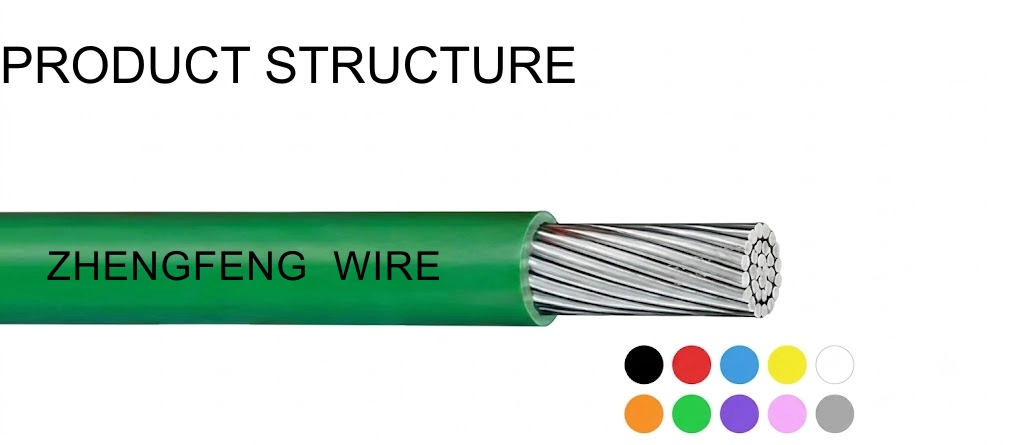
A typical UL1015 wire consists of three main components:
The conductor is usually made from high-quality stranded copper. Compared with solid copper wire, stranded construction provides better flexibility and makes installation easier, especially in applications where wires need to be routed around corners or connected repeatedly during assembly.
For demanding applications, manufacturers often provide tinned copper conductors. The tin coating improves oxidation resistance and solderability, making the wire more suitable for humid environments or applications requiring long-term reliability.
The insulation material of UL1015 wire is commonly PVC (Polyvinyl Chloride). PVC provides excellent balance between electrical insulation performance, mechanical protection, flexibility, and cost efficiency.
The insulation protects the conductor from:Electrical leakage,Short circuits,Mechanical damage,Environmental exposure.
UL1015 wire is available in various insulation colors,including:Black,Red,White,Blue,Yellow,Green,Brown.
Color identification helps engineers and technicians quickly recognize different circuits during installation and maintenance, reducing wiring errors.
Because of its combination of safety certification, reliable insulation, and wide size availability, UL1015 has become a standard choice for many electrical equipment manufacturers.
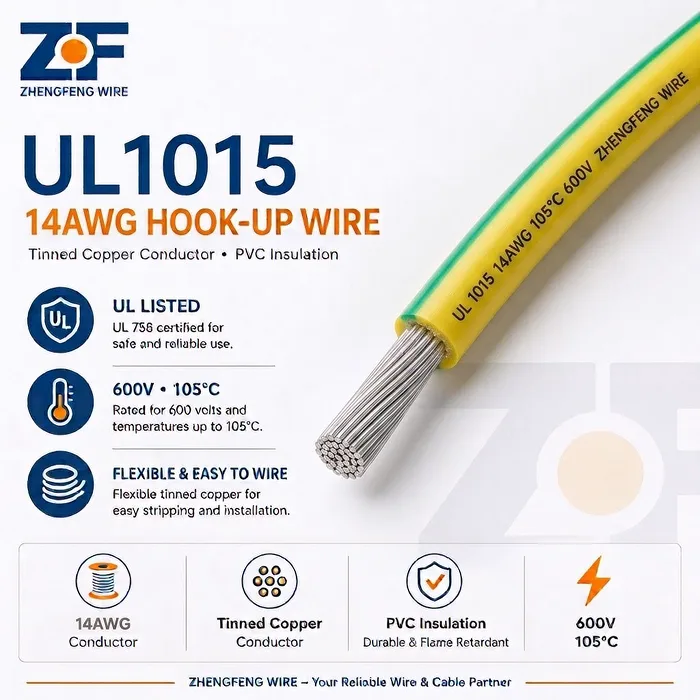
The main specifications of UL1015 wire include:
One of the most important characteristics of UL1015 is its electrical voltage rating.Standard UL1015 wire is typically rated 600V.
This makes it suitable for many internal wiring applications where higher voltage capability is required compared with lower voltage hook-up wires such as UL1007.
The 600V rating allows UL1015 to be used in:Industrial control equipment,Electrical panels,Appliances,Power supply systems,Automation equipment.
However, the actual application must always follow the equipment manufacturer's design requirements and applicable electrical codes.
2.Temperature Rating
UL1015 wire is generally rated 105°C.
The 105°C temperature rating means the insulation system is designed to maintain electrical and mechanical performance under continuous operating temperatures up to 105 degrees Celsius.
This makes UL1015 suitable for equipment where internal temperatures may increase due to:
Continuous operation,Heat generated by components,Limited ventilation,Compact equipment design
Compared with standard PVC wires with lower temperature ratings, UL1015 provides better thermal reliability.
One advantage of UL1015 wire is its wide AWG size availability.
Common sizes include:30 AWG,28 AWG,26 AWG,24 AWG,22 AWG,20 AWG,18 AWG,16 AWG,14 AWG,12 AWG,10 AWG.
Different AWG sizes provide different current carrying capabilities.
For example:
Small gauge wires such as 26 AWG or 28 AWG are commonly used for signal circuits and control wiring.
Medium sizes such as 18 AWG or 16 AWG are widely used for equipment internal power connections.
Larger sizes such as 12 AWG or 10 AWG are suitable for higher current applications.
Choosing the correct conductor size is critical. Using a wire that is too small may cause excessive heat generation, while selecting an oversized wire can increase unnecessary material costs and installation difficulty.
4.Conductor Material
Most UL1015 wire uses copper conductors because copper provides:
Stranded copper construction is preferred in many applications because it offers improved flexibility compared with solid wire.
For customers requiring better corrosion resistance and longer service life, tinned copper UL1015 wire can also be supplied.
The insulation thickness and finished diameter depend on the selected AWG size.
A larger conductor requires thicker insulation to maintain electrical safety requirements.
Engineers should consider:Available installation space,Terminal compatibility,Current requirements,Wire routing conditions.
Before mass production, it is recommended to confirm the exact specification with the wire manufacturer.
Selecting the correct AWG size is one of the most important decisions when purchasing UL1015 wire.
The AWG (American Wire Gauge) number represents conductor diameter. Interestingly, a smaller AWG number means a larger conductor size.
For example:
12 AWG is thicker than 18 AWG
18 AWG is thicker than 24 AWG
24 AWG is thicker than 30 AWG
A larger conductor can carry more current because it has lower electrical resistance.
| Common UL1015 AWG Applications |
||
| UL1015 18 AWG Wire | 18 AWG is one of the most popular sizes because it provides a good balance between flexibility and current capacity. |
Appliance internal wiring LED lighting equipment Control panels Power connections Electronic devices |
| UL1015 16 AWG Wire | 16 AWG provides higher current capability compared with 18 AWG. |
Motors Heating equipment Industrial machinery |
| UL1015 14 AWG and Larger Sizes | Larger UL1015 sizes are commonly selected for applications requiring higher electrical loads. |
Industrial equipment Battery-related systems Power supply connections Heavy-duty electrical assemblies |
| UL1015 22 AWG and Smaller Sizes |
Signal transmission Sensors Control circuits Low-current electronic devices |
|
The performance of an electrical wire depends not only on the conductor size but also on the insulation system surrounding the conductor. For UL1015 wire, PVC insulation is one of the key reasons the product has remained popular for internal equipment wiring for many years.
PVC, or polyvinyl chloride, is a thermoplastic insulation material widely used in electrical and electronic wiring. Its popularity comes from a practical combination of electrical insulation, mechanical protection, processing efficiency, and cost control.
For equipment manufacturers, this balance is important. A wire used inside a machine does not simply need to conduct electricity. It must also remain electrically stable when exposed to heat, vibration, bending, contact with other components, and the normal operating environment of the equipment.
The conductor is responsible for carrying electrical current, so conductor quality directly affects resistance, voltage drop, heat generation, and overall electrical efficiency.
UL1015 wire is commonly manufactured with copper conductors. Depending on the customer's requirements and production specification, the conductor may be supplied as bare copper or tinned copper.
Bare copper offers excellent conductivity and is widely used for standard internal wiring. Tinned copper adds a thin tin coating around the copper strands, providing improved resistance to oxidation and making the conductor particularly convenient for soldering and termination.
This distinction becomes more important in certain manufacturing environments. For example, if a wire will be soldered repeatedly during assembly, or if the finished equipment may operate in an environment where oxidation is a concern, tinned copper can provide additional advantages.
However, tinned copper is not automatically better for every application. Engineers should select the conductor finish according to the actual termination process, environment, electrical requirements, and cost target.
Another important consideration is conductor construction.
Compared with solid conductors, stranded copper consists of multiple smaller wires twisted together. This construction allows the finished wire to bend more easily and makes it easier for workers or automated equipment to route the wire through compact assemblies.
This is particularly useful in control cabinets and electrical equipment where wires may need to pass through Narrow wiring channels,Terminal blocks,Connector assemblies,Hinged equipment sections,Internal routing spaces,Areas with repeated movement.
For this reason, buyers should not evaluate an UL1015 wire only by AWG size. The conductor stranding specification can also influence flexibility, termination performance, and production efficiency.
PVC Insulation: More Than Just Electrical Protection
First, it provides electrical insulation between the copper conductor and surrounding components. This reduces the risk of short circuits and unintended electrical contact.
Second, it provides mechanical protection. During equipment assembly, wires may come into contact with terminals, brackets, housings, or other components. A properly designed insulation system helps protect the conductor from normal handling and installation stresses.
Third, PVC provides a practical solution for manufacturers who need reliable insulation without significantly increasing the cost of the finished product.
This is one reason UL1015 remains particularly attractive for large-volume equipment manufacturing. Engineers can obtain a UL-recognized internal wiring solution while maintaining a relatively economical material structure.
A common purchasing mistake is to treat every UL1015 wire with the same nominal specification as identical.
Two products may both be described as “18 AWG UL1015,” but their actual construction can differ in areas such as Strand count,Strand diameter,Conductor material,Tinning,Insulation thickness,Finished outer diameter,Color,Flexibility,Production tolerance.
These differences can influence how easily the wire fits a terminal, how much space it occupies inside an enclosure, and how efficiently it can be processed during assembly.
For OEM customers, therefore, the most useful approach is to define the complete wire specification rather than simply asking for “UL1015 18 AWG.”
One of the most common questions from engineers and purchasing teams is whether UL1015 is interchangeable with other UL hook-up wire styles.
The short answer is: not necessarily.
UL1007, UL1569, UL1015, and other AWM constructions may look similar because they are all commonly used for internal electrical wiring. However, their voltage ratings, temperature ratings, insulation constructions, and intended applications can differ.
Understanding these differences can prevent a common engineering problem: selecting a wire based solely on appearance or price rather than its actual specification.
UL1007 is another widely used PVC hook-up wire.
The major difference is that standard UL1007 is commonly associated with a 300V rating and a 80°C temperature rating, while UL1015 is commonly specified at 600V and 105°C.
This gives UL1015 a higher voltage and temperature rating and makes it suitable for applications where additional electrical and thermal margin is required.
For example, if an equipment designer is working with an internal circuit where the voltage requirement exceeds the typical rating of UL1007, UL1015 may be the more appropriate choice.
However, choosing UL1015 simply because it has a higher rating is not always the most economical solution. If a circuit only requires the electrical performance of UL1007, using a higher-rated wire may add unnecessary cost or increase the finished wire diameter.
The correct question is not:“Which wire has the highest rating?”
It is:“Which wire specification provides the required safety and performance margin for this application?”
That approach leads to better engineering and purchasing decisions.
UL1569 is another common style of appliance wiring material used in electrical and electronic equipment.
Compared with UL1015, UL1569 is generally associated with a 300V rating and can have different construction requirements depending on the specific product configuration.
The choice between UL1015 and UL1569 should therefore be based on the equipment's voltage, temperature, mechanical requirements, available installation space, and applicable certification requirements.
Why “AWM 1015” Appears on Technical Documents
Engineers may encounter AWM 1015 instead of simply “UL1015 wire” on drawings, labels, specifications, or supplier documentation.
AWM means Appliance Wiring Material.The number 1015 identifies the specific UL AWM style.
Therefore, when an engineering drawing specifies AWM 1015, the purchasing team should verify that the proposed wire actually meets the required UL style rather than assuming that any PVC hook-up wire is acceptable.
This distinction becomes especially important for OEM production.
A wire may physically look almost identical to another product but have a different certification or construction. Substituting it without engineering approval can create problems during product certification, factory inspection, or customer quality audits.
The broad application range of UL1015 wire is one of its biggest advantages.Because of its combination of a 600V rating, 105°C temperature rating, PVC insulation, and broad AWG availability, it can be used in many types of internal electrical assemblies.
However, application suitability should always be determined by the complete equipment design and applicable standards. A wire's UL style alone does not automatically mean that it is suitable for every electrical environment.
Control cabinets often contain dozens or even hundreds of individual electrical connections.
Wires connect Circuit breakers,Relays,Contactors,PLC systems,Terminal blocks,Sensors,Power supplies,Control switches.In these applications, color identification and flexible stranded construction can significantly improve assembly efficiency.
For example, an engineering team may specify different colors for power, control, grounding, and signal circuits. This makes troubleshooting easier when equipment requires maintenance.
UL1015 is therefore frequently considered for internal control-panel wiring where its electrical rating and insulation characteristics meet the equipment requirements.
Modern automation equipment often combines motors, sensors, actuators, controllers, and communication systems inside a relatively compact machine.
Internal wiring may need to pass around components and through narrow routing channels.
A stranded UL1015 wire can provide the flexibility required for practical assembly while maintaining the electrical insulation required for the circuit.
Typical equipment can include Automated production lines,Packaging machinery,CNC equipment,Industrial controllers,Robotics-related equipment,Conveyor systems,Assembly machines.
The exact wire size depends on the current load and circuit design.
UL1015 can also be used for internal wiring in electrical appliances where its specification is appropriate.
Potential applications include Refrigeration equipment,Air-conditioning equipment,Heating appliances,Kitchen appliances,Washing machines,Industrial and commercial appliances.
In appliance manufacturing, wire selection often involves more than voltage and temperature.
Manufacturers may also evaluate Available internal space,Terminal compatibility,Flame characteristics,Flexibility,Assembly method,Production cycle,Certification requirements.
This is why OEM appliance manufacturers typically provide detailed wire specifications rather than simply requesting a generic PVC wire. If your are not sure about it , ZHENGFENG WIRE team can help you.
Internal wiring is another potential application.
Lighting systems can contain LED drivers, switches, power supplies, control circuits, and other electrical components. Depending on the equipment design, UL1015 may be used for internal connections where its voltage and temperature specifications are appropriate.
For compact lighting equipment, the finished outer diameter of the wire can become an important consideration.A wire that is electrically suitable but physically too large may make routing difficult or increase assembly time.Therefore, engineers should evaluate both electrical performance and physical dimensions when selecting the AWG and insulation construction.
Motors, transformers, relays, power supplies, and other electrical components may also require internal hook-up wiring.In these applications, thermal conditions deserve particular attention.
Electrical current creates heat within a conductor, while nearby components can also generate heat. If several wires are bundled together in a confined area, the actual thermal environment may be significantly different from an open-air installation.
This means that simply looking at the nominal 105°C temperature rating is not enough.Engineers should consider Actual operating temperature,Current load,Wire bundling,Ambient temperature,Ventilation,Installation method,Required safety margin.
ZHENGFENG wire supplier can help customers review these factors before finalizing a wire specification.
From an OEM perspective, one of the biggest advantages of UL1015 wire is not a single technical parameter but the combination of multiple characteristics.
A manufacturer may need a wire that is:
UL recognized + 600V rated + 105°C rated + available in multiple AWG sizes + easy to process + available in multiple colors + suitable for volume production.
UL1015 can meet this general requirement for many internal wiring applications.This makes it particularly useful when an equipment manufacturer wants to standardize internal wiring across multiple product models.
For example, an equipment company may use different AWG sizes depending on current requirements while maintaining the same general UL1015 wire family.
A procurement department can then simplify sourcing by establishing approved specifications for 18 AWG,16 AWG,14 AWG,12 AWG,10 AWG etc. rather than sourcing completely different wire constructions for every circuit.This can improve purchasing efficiency, inventory management, and production consistency.
At the same time, standardization should not replace engineering verification. Each application still needs to be checked for current, voltage, temperature, mechanical conditions, termination requirements, and applicable product standards.
A Practical Specification Checklist for Buyers
Before ordering UL1015 wire, purchasing teams should provide the supplier with more information than just the AWG number. A useful RFQ specification can include:
Providing this information at the quotation stage helps the manufacturer identify the correct construction and reduces the possibility of receiving a wire that technically carries the same UL style number but does not fit the customer's actual assembly requirements.
Choosing the correct UL1015 wire is only half of the job. For OEM manufacturers, electrical equipment companies, and distributors, selecting a reliable wire manufacturer is equally important.
A product may have the correct nominal specification, but inconsistent conductor construction, insulation thickness, outer diameter, color, packaging, or production quality can create problems during assembly. For customers purchasing UL1015 wire in large quantities, supplier capability can directly affect production efficiency and product quality.
Therefore, when evaluating an AWM 1015 supplier, it is better to look beyond the quotation price and evaluate the supplier from several technical and commercial perspectives.
The first step is to verify that the manufacturer's product actually corresponds to the required UL wire style.
If your engineering specification requires UL1015, the wire supplier should be able to provide appropriate certification information and product documentation.
The purchasing team should confirm:
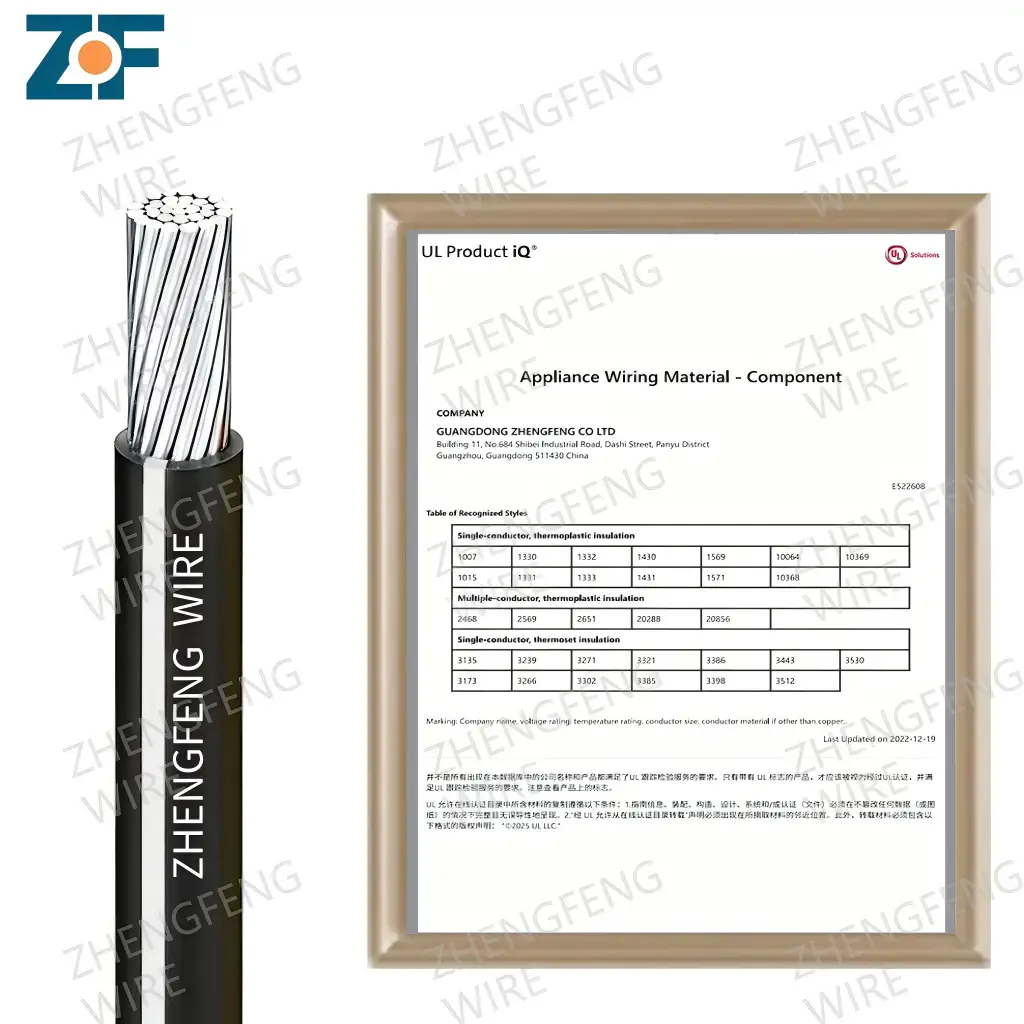
UL file No.: E522608
UL style: UL1015
Manufacturer information: GUANGDONG ZHENGFENG
Conductor construction: Required strand construction
Insulation material: pvc insulation
Voltage rating: 600V
Temperature rating: 105℃
Applicable wire sizes: 2awg-28awg
2. Evaluate Copper Quality and Conductor Consistency
Copper represents one of the most important raw materials in electrical wire manufacturing.
Poor conductor quality can result in increased resistance, inconsistent electrical performance, and unexpected heating under load.For this reason, buyers should pay attention to conductor material rather than simply comparing the selling price per meter or kilogram.
A professional manufacturer should have appropriate incoming material controls for copper rod, copper wire, and other raw materials.
For stranded UL1015 wire, buyers should also confirm whether the conductor construction meets the agreed specification.
For example, an 18 AWG wire may be produced using different strand combinations. These constructions can affect flexibility, electrical performance, and compatibility with terminals.
For high-volume OEM projects, maintaining the same conductor construction from batch to batch is particularly important.
Before placing a large order, engineers should test the actual wire in the intended application.
The sample evaluation can include:
Electrical testing: resistance, insulation performance, and voltage-related requirements.
Mechanical testing: flexibility, stripping performance, terminal compatibility, and bending behavior.
Assembly testing: cutting, stripping, crimping, soldering, routing, and connector installation.
Environmental evaluation: performance under the expected operating temperature and other relevant conditions.
At first glance, UL1015 may appear to be a simple PVC hook-up wire. In reality, selecting the correct product involves evaluating multiple factors, including conductor material, AWG size, insulation construction, voltage rating, temperature rating, dimensional requirements, certification, and application conditions.
The standard UL1015 configuration is widely associated with 600V and 105°C ratings, making it a practical choice for many internal wiring applications where these electrical and thermal ratings are appropriate.
Its broad AWG range also makes it possible to select different conductor sizes according to circuit requirements.
Smaller sizes can be used for lower-current control and signal circuits, while larger sizes can support higher-current internal connections. Stranded copper construction provides practical flexibility for equipment assembly, while PVC insulation offers a balance between electrical protection, mechanical durability, manufacturability, and cost.
However, one of the most important lessons for buyers is that AWG size alone does not define a complete wire specification.
When purchasing UL1015, it is important to consider:
What current will the circuit carry?
What voltage will the wire experience?
What temperature will the wire encounter?
How much installation space is available?
Does the conductor need to be bare or tinned copper?
How will the wire be stripped and terminated?
Does the finished product require specific certification?
Will the wire be processed manually or automatically?
What documentation does the equipment manufacturer require?
For companies sourcing UL1015 wire for OEM equipment, industrial machinery, electrical panels, appliances, lighting systems, and electronic products, supplier capability is equally important.
A professional wire manufacturer should be able to provide consistent conductor construction, stable insulation dimensions, reliable production quality, appropriate certification documentation, customized colors and packaging, and technical support during product development.
At Zhengfeng Wire & Cable, we understand that electrical wire is not simply a commodity purchased by AWG size.
Different equipment manufacturers have different requirements for conductor construction, flexibility, insulation dimensions, color, packaging, certification, and production consistency.
Our team supports customers from initial wire selection and sample evaluation through mass production, helping engineers and purchasing teams identify a suitable wire specification for their actual application.
Whether you are sourcing UL1015 18 AWG wire, UL1015 16 AWG wire, larger AWG sizes for higher-current internal connections, or smaller sizes for control and electronic circuits, the right specification should always be determined by the complete application rather than price alone.
If you are developing a new electrical product or looking for a stable UL1015 wire supplier, contact the Zhengfeng team to discuss your conductor, insulation, AWG, certification, packaging, and OEM requirements.
Guangdong Zhengfeng Wire&Cable Co., Ltd.
Tel/WhatsApp/Wechat: +86 13829292517
Tel/WhatsApp/Wechat: +86 14749307879
Email: manager01@wire-cablemanufacturer.com
Website: www.wire-cablemanufacturer.com


Products
Navigation
QR Code


Copyright © 2026 Guangdong Zhengfeng Wire&Cable Technology Co., Ltd.