 Zhengfeng
 Sep 30,2026

Content
1. What Do UL 1007, UL 1015 and UL 1061 Mean?
2. UL 1007 Wire: General-Purpose PVC Hook-Up Wire
3. UL 1015 Wire: Higher Voltage and Temperature Capability
4. UL 1061 Wire: Thin-Wall, Space-Conscious Hook-Up Wire
5. UL 1007 vs UL 1015: What Is the Difference?
6. UL 1007 vs UL 1061: What Is the Difference?
7. UL 1015 vs UL 1061: What Is the Difference?
8. Why Insulation Thickness Matters?
9. Does AWG Make These Three Wires Equivalent?
10. Which Wire Should You Choose?
11. Can UL 1007, UL 1015 and UL 1061 Replace Each Other?
12. UL 1007 vs UL 1015 vs UL 1061 for Wire Harnesses
14. What Should You Ask a Hook-Up Wire Manufacturer?
15. UL 1007, UL 1015 and UL 1061 from a Purchasing Perspective
16. How Zhengfeng Supports UL Hook-Up Wire Sourcing
17. Final Comparison: UL 1007 vs UL 1015 vs UL 1061
When engineers and purchasing teams search for UL hook-up wire, three commonly specified wire styles are UL 1007, UL 1015 and UL 1061. Although all three are used for internal electrical wiring and may look similar at first glance, they are not the same wire construction.
The differences become important when you consider voltage rating, temperature rating, insulation construction, conductor size, finished outside diameter, flexibility, installation space and end-product requirements.
Choosing between UL 1007, UL 1015 and UL 1061 should therefore not be based only on the printed voltage rating or AWG size. The correct wire needs to match the electrical and mechanical requirements of the equipment in which it will be installed.
This guide compares UL 1007, UL 1015 and UL 1061 and explains where each wire style may fit, what makes them different, and what engineers and buyers should check before approving a wire for production.
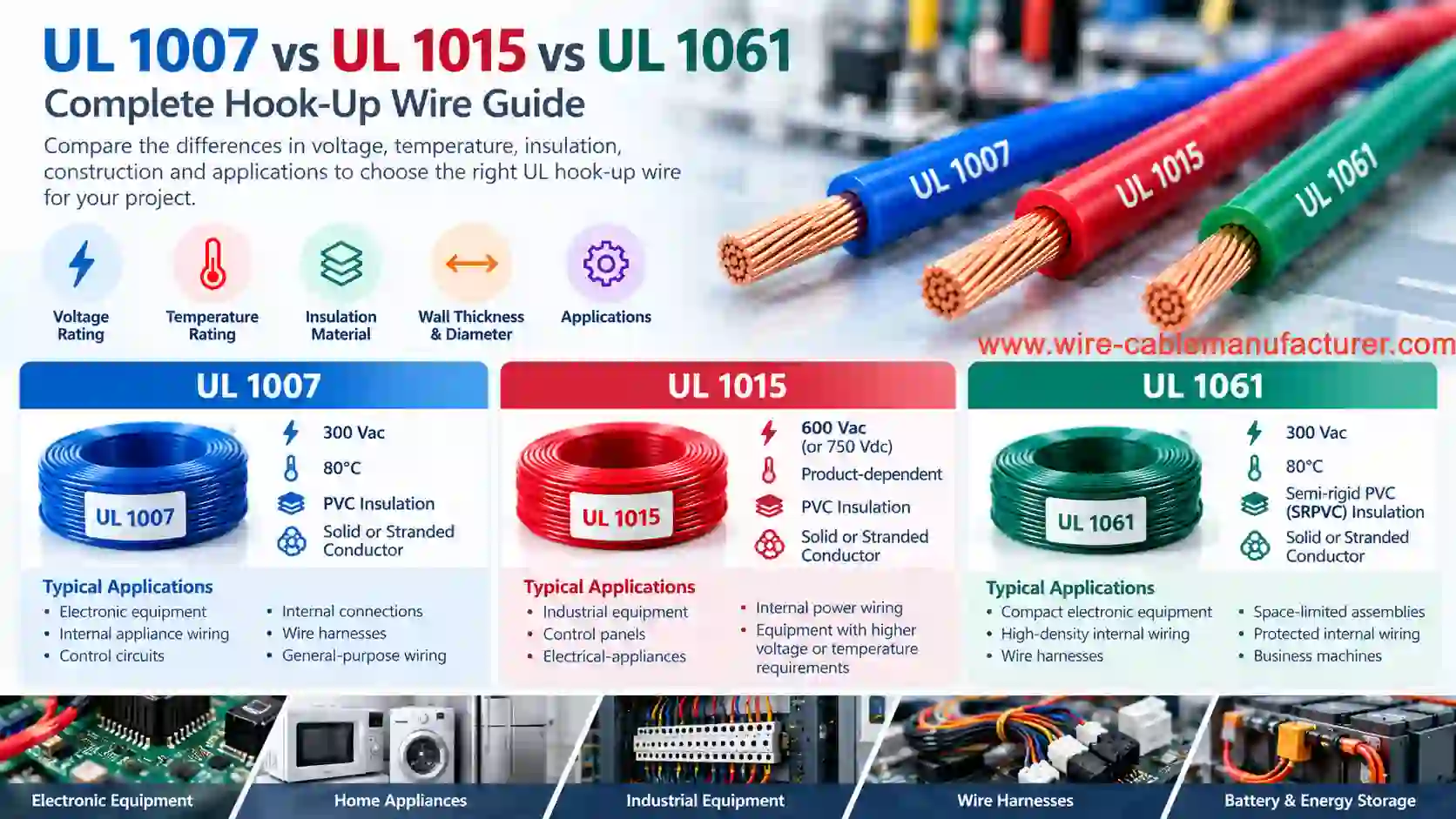
The easiest way to understand these three hook-up wire styles is to compare their major characteristics.
| Feature |
UL 1007 |
UL 1015 |
UL 1061 |
| Common classification | AWM Style 1007 | AWM Style 1015 | AWM Style 1061 |
| Typical voltage rating | 300 Vac | Up to 600 Vac depending on certified product | 300 Vac |
| Temperature | 80°C | Product-dependent; Style permits higher temperature ratings | 80°C |
| Insulation | PVC | PVC | Semi-rigid PVC (SRPVC) |
| Construction | Single conductor | Single conductor | Single conductor |
| Typical role | General internal wiring | Higher-rated internal wiring | Space-conscious protected internal wiring |
| Insulation construction | Standard PVC | Thicker PVC construction | Thin SRPVC construction |
| Conductor options | Solid or stranded | Solid or stranded | Solid or stranded |
| Key selection factor | General-purpose internal wiring | Higher voltage/temperature requirements | Smaller insulation construction and protected routing |
The table provides a high-level comparison. Actual commercial wire specifications should always be checked against the manufacturer's current datasheet and certification because conductor ranges, temperature ratings, dimensions and other details can vary according to the certified construction.
First, it is useful to understand what these numbers actually represent.
UL 1007, UL 1015 and UL 1061 are commonly used industry names for different Appliance Wiring Material (AWM) Styles.
In technical specifications, they are more precisely referred to as:
They are different wire constructions rather than three different names for exactly the same hook-up wire.
This distinction matters because two wires with the same conductor size may have different insulation systems, outside diameters, temperature ratings, voltage ratings and application conditions.
For purchasing teams, specifying only:“20 AWG UL wire”may not provide enough information for a manufacturer to identify the correct product.
A more complete specification should include the required UL Style, AWG, conductor construction, insulation material, voltage, temperature, color and application.
UL 1007 is one of the most commonly requested PVC-insulated hook-up wire styles for electronic and electrical equipment.
A typical AWM Style 1007 construction is rated 80°C and 300 Vac and uses extruded PVC insulation.
It is commonly considered when equipment requires a relatively compact single-conductor wire for internal connections.
Typical UL 1007 characteristics
UL 1007 can be used in applications such as:
Its combination of PVC insulation, flexibility and broad availability makes UL 1007 a common choice for general internal wiring.
However, the final application must still meet the specific requirements of the wire's certified construction and the end product.
UL 1015 is another widely used PVC-insulated hook-up wire style, but it is constructed differently from UL 1007.
One of the most important differences is its higher voltage capability. AWM Style 1015 permits 600 Vac or 750 Vdc under its published Style definition, while the actual temperature rating of a commercial UL1015 product should be confirmed from its certification and datasheet.
UL 1015 also uses a substantially thicker insulation construction than UL 1007 at common overlapping conductor sizes.
Typical UL 1015 characteristics
UL 1015 is commonly considered for:
Because its insulation construction is thicker, UL 1015 may have a larger finished outside diameter than a comparable UL 1007 wire with the same conductor size.
This can affect routing space, terminal compatibility and wire harness bundle size.
UL 1061 is different from both UL 1007 and UL 1015 because it uses semi-rigid PVC, commonly abbreviated as SRPVC, with a thinner insulation construction.
AWM Style 1061 is typically rated 80°C and 300 Vac.
Its thinner insulation construction can make it attractive for applications where internal space is limited.
Typical UL 1061 characteristics
Typical application areas may include:
However, UL 1061 should not simply be described as “a thinner UL 1007.”It is a distinct AWM Style with its own construction requirements and application conditions.
The most obvious difference between UL 1007 and UL 1015 is their voltage capability.
UL 1007
Typically: 300 Vac / 80°C / PVC
UL 1015
The Style permits: 600 Vac or 750 Vdc / temperature rating according to certified product / PVC
However, voltage and temperature are not the only differences. The insulation construction is also important.
UL 1015 generally uses a thicker insulation construction than UL 1007 at common overlapping conductor sizes. This can provide a different mechanical and electrical construction, but it can also increase the finished wire diameter.
Therefore: UL 1015 is not simply a “better UL 1007.”
It is a different wire construction intended for applications with different requirements.
If an equipment drawing specifies UL 1007, changing to UL 1015 should not be treated as an automatic upgrade.
The engineering team should review:
This comparison is especially interesting because both styles are commonly associated with 300 Vac and 80°C constructions.
The major difference is their insulation construction.
UL 1007
Uses PVC insulation with a thicker minimum insulation construction.
UL 1061
Uses semi-rigid PVC insulation with a thinner minimum insulation construction.
This difference can influence the final outside diameter of the wire.
For compact equipment, reducing insulation thickness can help engineers manage:
However, a smaller outside diameter does not automatically mean UL 1061 is the better choice.
The wire still needs to satisfy the application's mechanical protection and end-product requirements.
UL 1015 and UL 1061 represent two substantially different approaches to internal wiring.
UL 1015 focuses on a higher-rated, thicker PVC construction that can support higher voltage and temperature requirements depending on the certified product.
UL 1061 focuses on a thinner SRPVC construction for protected internal applications.
In simple terms:
UL 1015 → higher-rated, thicker construction
UL 1061 → thinner, space-conscious construction
The correct choice depends on the equipment design.
For example, if an application requires a 600 Vac-rated wire, UL 1061 would not be selected simply because it has a smaller diameter.
Conversely, if the application only requires a 300 Vac / 80°C construction and has strict internal space limitations, the thinner construction of UL 1061 may be worth evaluating if it is permitted by the end-product design.
One of the most overlooked differences between UL 1007, UL 1015 and UL 1061 is insulation thickness.
The same conductor size can produce different finished wire diameters depending on the insulation construction.
For example, a 20 AWG UL 1007 and a 20 AWG UL 1015 do not necessarily have the same outside diameter.
This matters when wire is installed inside:
A larger wire OD can affect terminal fit and bundle size, while a thinner construction may help reduce the amount of space required.
For this reason, purchasing teams should not specify wire based on AWG alone.
A better specification includes:
UL Style + AWG + conductor construction + insulation + voltage + temperature + required OD
No. AWG describes the conductor size, not the complete wire construction.
For example, three products could all be 20 AWG:
But they can still have different:
This is why: The same AWG does not mean the same wire.
For engineers designing a wire harness or electrical assembly, the complete wire specification should be evaluated.
There is no universally “best” choice among UL 1007, UL 1015 and UL 1061.
The appropriate wire depends on the application.
Choose UL 1007 when:
The equipment requires a PVC-insulated, single-conductor AWM construction with an appropriate 300 Vac / 80°C rating and the wire's physical dimensions and application conditions fit the design.
Typical applications include:
Consider UL 1015 when:
The application requires a higher voltage or temperature capability permitted by the certified product, or requires the heavier PVC insulation construction associated with this Style.
Typical applications include:
Consider UL 1061 when:
The equipment design allows its 80°C / 300 Vac construction and benefits from a thinner SRPVC insulation system for protected internal wiring.
Typical applications include:
The final decision should always be based on the approved end-product requirements and the current product certification.
This is one of the most important questions for purchasing teams.
The short answer is: Not automatically.
A wire should not be approved as a substitute simply because:
A proper substitution review should consider:
For OEM projects, changing the specified UL Style may require engineering approval before production.
This is particularly important when the wire is part of a certified electrical product.
Wire harness manufacturers often need to balance electrical performance with physical dimensions and assembly efficiency.
The choice of hook-up wire can affect:
For example, a compact harness may place greater importance on finished wire OD, while an industrial application may prioritize voltage and temperature requirements.
Therefore, wire harness manufacturers should provide the supplier with more information than simply:“20 AWG hook-up wire.”
A better inquiry could specify:
AWM Style 1007, 20 AWG, stranded copper, PVC insulation, required color, required quantity and application.
This gives the manufacturer a much clearer specification to work from.
Use the following guide as an initial screening tool.
This table is a starting point rather than a substitution chart. The final selection should be confirmed against the actual wire certification and end-product requirements.
When requesting a quotation for UL 1007, UL 1015 or UL 1061, providing complete technical information can make the sourcing process faster.At minimum, consider providing:
Product specification
Application information
Commercial information
A professional wire manufacturer can then confirm whether the requested construction is available and whether customization is required.
For purchasing teams, price should not be the only factor used to compare these three wire styles.
A lower unit price may not result in a lower overall project cost if the wire creates problems during:
Assembly/ Stripping/ Terminal insertion/ Connector fitting/ Harness routing/ Certification/ Production testing
The finished wire should therefore be evaluated based on its complete specification and application compatibility.
When comparing quotations from different suppliers, purchasing teams should make sure they are comparing equivalent constructions.
For example: 20 AWG UL 1007 and 20 AWG UL 1015
should not automatically be treated as two interchangeable quotations simply because the conductor gauge is identical.
Guangdong Zhengfeng Wire & Cable Co., Ltd. supplies a range of UL hook-up wires and electronic wires for equipment manufacturers, wire harness manufacturers and international purchasing teams.
Our product range includes different UL wire styles and constructions, including:
UL 1007,UL 1015,UL 1569,UL 1332,UL 3239,UL 3266,UL 3321,UL 3512 and other electronic and specialty wire constructions.
Products can be supplied in different AWG sizes, conductor constructions, insulation materials and colors according to the applicable product specification.
For projects where the exact wire style is unclear, buyers can provide the application, required voltage, temperature, AWG, equipment type and existing wire specification. This allows the manufacturer to evaluate the requested construction more accurately.
Zhengfeng also supports OEM purchasing, custom packaging, sample requirements and application-specific wire sourcing.
UL 1007, UL 1015 and UL 1061 are all important hook-up wire options, but they serve different specification requirements.
UL 1007 is commonly used as a general-purpose PVC-insulated hook-up wire for internal electronic and electrical wiring.
UL 1015 provides a different, heavier PVC construction and permits higher voltage and temperature ratings depending on the certified product.
UL 1061 uses a thinner SRPVC insulation construction and can be considered where protected internal wiring and space efficiency are important.
The key point is simple: Do not choose hook-up wire based on AWG or voltage alone.
The correct selection should consider the complete combination of UL Style, voltage, temperature, conductor construction, insulation, outside diameter, installation environment and end-product requirements.
If you are comparing UL 1007, UL 1015 and UL 1061 for an OEM project, wire harness, appliance or electronic equipment, provide the complete application requirements to your wire manufacturer before approving a substitute.
UL 1007 is typically an 80°C, 300 Vac PVC-insulated AWM construction. UL 1015 permits higher voltage and temperature ratings depending on the certified product and uses a different, generally thicker PVC insulation construction.
Not universally. UL 1015 provides higher permitted ratings in relevant certified constructions, but its thicker insulation can also result in a larger outside diameter. The correct choice depends on the application.
UL 1061 is an AWM Style using semi-rigid PVC insulation. It is typically rated 80°C and 300 Vac and uses a thinner insulation construction than UL 1007.
Both are commonly associated with 80°C and 300 Vac applications, but UL 1061 uses a thinner SRPVC insulation construction and has different construction and application requirements.
Not automatically. The voltage, temperature, insulation construction, outside diameter and end-product requirements must be reviewed before substitution.
Not automatically. Although UL 1015 can provide higher ratings in applicable certified constructions, its different insulation construction and dimensions may affect the equipment design.
There is no universal best option. UL 1007, UL 1015 or UL 1061 may be appropriate depending on the harness voltage, temperature, space, terminal, connector and certification requirements.
UL 1061 has a thinner minimum insulation construction, which can allow a smaller finished wire diameter, although actual OD depends on the complete manufacturer-specific construction.
They are commonly used as hook-up wire styles, but they represent different AWM constructions and should not be treated as identical products.
Provide the UL Style, AWG, conductor construction, insulation material, voltage, temperature, color, quantity and application. For OEM projects, also provide the existing drawing or wire specification when available.
The difference between UL 1007, UL 1015 and UL 1061 is not simply a difference in voltage rating.
Their insulation construction, thickness, temperature capability, physical dimensions and application requirements can all affect the final selection.
For engineers and purchasing teams, the most reliable approach is to select the wire according to the complete equipment specification rather than choosing the wire with the highest rating.
Need help selecting UL 1007, UL 1015 or UL 1061 hook-up wire? Contact Zhengfeng Wire & Cable with your AWG, voltage, temperature, application and quantity requirements.


Products
Navigation
QR Code


Copyright © 2026 Guangdong Zhengfeng Wire&Cable Technology Co., Ltd.