 Zhengfeng
 Sep 09,2026

Content
Ⅰ. What Is UL1015 Wire and Why Is It Widely Used?
Ⅱ. What Are the Main Specifications of UL1015 Wire?
Ⅲ. What Is UL1015 Wire Used For?
Ⅳ. How Do You Choose the Right UL1015 Wire for Your Equipment?
Ⅴ. UL1015 vs. Other Hook-Up Wires: When Should You Choose It?
If you are sourcing wiring for electrical equipment, control panels, power supplies, industrial machines, or household appliances, you may have come across the term UL1015 wire. But what is UL1015 wire actually used for, and why do engineers and manufacturers choose it instead of other hook-up wires?
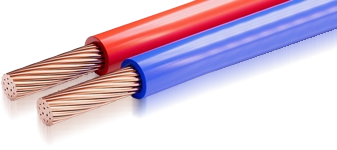
UL1015 is a widely used 600V 105°C hook-up wire designed primarily for internal wiring of electrical and electronic equipment. Its combination of a PVC insulation system, copper conductor, relatively high voltage rating, and 105°C temperature rating makes it suitable for a wide range of equipment where reliable point-to-point internal wiring is required. Depending on the construction and certification configuration, UL1015 wire may use bare copper or tinned copper conductors and can be manufactured in different AWG sizes and colors.
For engineers and purchasing teams, however, the most important question is not simply “What is UL1015?” but “Where can UL1015 be used, and which applications benefit most from its specifications?”
This guide explains the construction, electrical characteristics, common applications, AWG selection, export-market considerations, and frequently asked questions about UL1015 wire. It is written from both an engineering and procurement perspective so that manufacturers can determine whether UL1015 is the right wiring solution for their equipment.
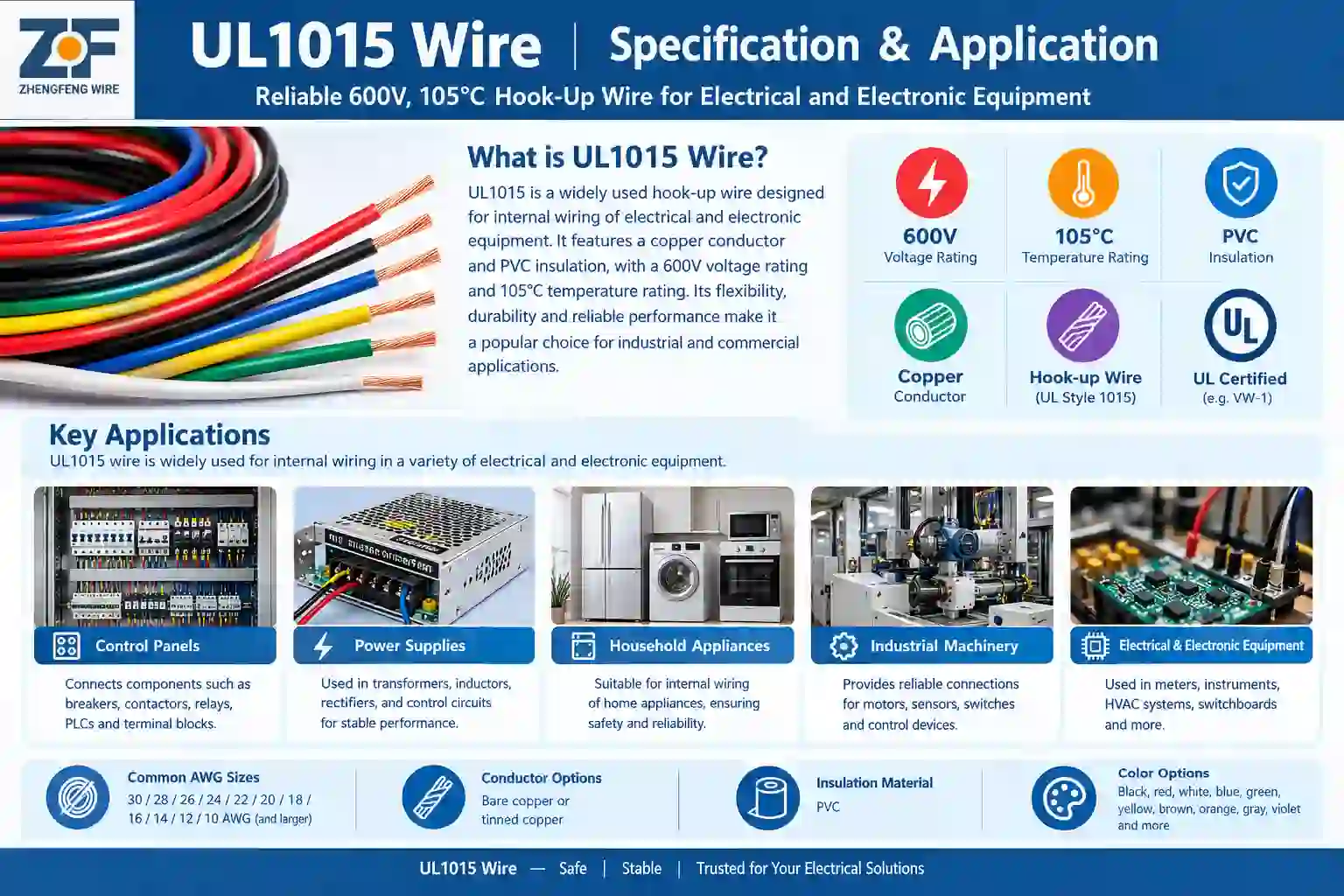
UL1015 wire is a recognized hook-up wire style commonly used for internal electrical connections. It is generally manufactured with a copper conductor and PVC insulation and is rated at 600 volts and 105°C. Industry product specifications commonly identify it as UL Style 1015 or AWM 1015, while some constructions may carry additional ratings such as TEW or MTW depending on the specific product and certification.
The term“hook-up wire” is important because UL1015 is generally not intended to replace every type of building wire, flexible cable, or appliance power cord. Instead, its strength is internal wiring: connecting components, terminals, switches, relays, circuit protection devices, power supplies, motors, control components, meters, and other electrical assemblies within equipment.
A typical UL1015 construction consists of a copper conductor surrounded by PVC insulation. The conductor can be stranded for improved flexibility or, depending on the specification, solid. Tinned copper is frequently selected when additional resistance to oxidation and easier termination characteristics are desired, while bare copper can also be used for suitable applications.
The 600V rating is one of the main reasons UL1015 is selected over lower-voltage hook-up wire styles. For example, commonly compared UL1007 wire is generally rated at 300V, while UL1015 is commonly specified at 600V and 105°C. This does not mean that a UL1015 wire should automatically be used at 600V in every installation; the actual allowable application depends on the complete equipment design, applicable standards, conductor size, installation method, ambient conditions, and the manufacturer's certification.
The 105°C temperature rating is another important advantage. Electrical equipment often contains components that generate localized heat, especially around power supplies, transformers, motors, relays, resistors, terminals, and control devices. A wire with a 105°C rating provides a wider thermal operating range than many general-purpose lower-temperature wires, provided that the complete application remains within the relevant certification and installation requirements.
This combination explains why UL1015 continues to be a popular choice for electrical equipment manufacturers: it offers a practical balance between voltage capability, temperature resistance, flexibility, manufacturability, and cost.
For purchasing teams, another advantage is the broad range of available sizes. Commercial UL1015 products are available in small control-wire sizes such as 24, 22, 20 and 18 AWG as well as larger sizes including 16, 14, 12 and 10 AWG,with some manufacturers offering even larger sizes.
When engineers evaluate UL1015 wire, the first specifications they normally check are voltage rating, temperature rating, conductor material, conductor construction, insulation material, AWG size, insulation thickness, outside diameter, flexibility, flame performance, and certification.
The standard configuration is commonly summarized as:
| Specification |
Typical UL1015 Configuration |
| UL Style |
UL1015 |
| Wire Type |
Hook-up wire |
| Rated Voltage |
600V |
| Rated Temperature |
105°C |
| Insulation |
PVC |
| Conductor |
Copper |
| Conductor Type |
Solid or stranded, depending on construction |
| Common Conductor Options |
Bare copper or tinned copper |
| Flame Performance |
UL VW-1 / applicable certification |
| Common Applications |
Internal wiring of electrical and electronic equipment |
The 600V / 105°C combination is particularly important because it gives UL1015 a wider operating envelope than many low-voltage electronic hook-up wires. Several commercial specifications also indicate compliance with UL VW-1 flame testing, while CSA-related ratings may apply to particular constructions. However, engineers should always verify the actual certification markings and test standards of the specific wire being purchased rather than assuming that every UL1015 product carries identical additional approvals.
AWG selection is equally important. A smaller AWG number means a larger conductor and generally allows greater current-carrying capability, subject to the applicable ampacity rules and installation conditions. For example, 18 AWG and 20 AWG are commonly used for relatively smaller power and control circuits, while 14 AWG, 12 AWG, and 10 AWG are more appropriate for applications requiring larger conductors. A manufacturer's data sheet may specify conductor strand counts, conductor diameter, insulation thickness, overall diameter, and maximum conductor resistance for each size.
As an example, one UL1015 specification lists 20 AWG with a conductor resistance of approximately 36.7 Ω/km and 14 AWG at approximately 8.96 Ω/km, illustrating the significant electrical difference created by conductor size. The actual resistance depends on conductor material, construction, temperature, and manufacturing tolerances, so engineers should always use the supplier's current datasheet for final design calculations.
Insulation thickness also changes according to the wire size and construction. A typical UL1015 product may use approximately 0.76–0.80 mm nominal insulation thickness in many AWG ranges, while larger sizes may require thicker insulation systems. Product specifications should therefore be checked individually rather than assuming one dimensional standard applies to every UL1015 wire.
Another factor is color. UL1015 is commonly supplied in black, red, white, blue, green, yellow, brown, orange, gray, violet, and other colors. Color coding is not merely cosmetic: in control panels and equipment wiring, different colors can help technicians identify power, control, grounding, signal, and other circuits during assembly and maintenance.
For OEM customers, customization can also be important. Depending on the supplier's manufacturing capability, UL1015 wire can be supplied in different conductor constructions, colors, printing configurations, packaging lengths, striping patterns, and cut-to-length formats. These options can reduce assembly time when the wire is being incorporated into repetitive production processes.
So, what is UL1015 wire used for? UL1015 is primarily used for internal wiring of electrical and electronic equipment, appliances, control panels, machinery, power supplies, meters, and similar equipment where a 600V, 105°C hook-up wire is appropriate.
Commercial hook-up wire suppliers identify applications including control panels, industrial machinery, appliances, switchboards, HVAC equipment, power supplies, testing equipment, and other electrical assemblies.
One of the most practical applications for UL1015 is internal wiring inside electrical control panels.
A modern control cabinet may contain circuit breakers, contactors, relays, terminal blocks, PLCs, power supplies, switches, sensors, motor controllers, and other components. These devices need reliable point-to-point electrical connections, and the wiring must often be routed through relatively tight spaces.
This is where stranded hook up wire such as UL1015 becomes useful. The stranded copper construction can provide the flexibility needed to route wires between terminal blocks and components while maintaining a relatively compact installation. In industrial machinery, the wire may carry control signals, auxiliary power, relay outputs, or other electrical connections depending on the system architecture.
Trade data also demonstrates the scale of the broader electrical equipment market. According to Volza's shipment database, China accounted for a large share of global electrical control panel export shipments, with more than 46,000 shipments recorded in its cited dataset. The United States was among the important destination markets.
This does not mean that every control panel exported from China uses UL1015 wire. Trade databases generally classify the finished equipment rather than identifying the exact internal wire style. However, it does demonstrate why control panels and industrial electrical equipment are commercially relevant application sectors for UL-certified internal wiring.
A second important application is the internal wiring of power supplies and electrical equipment.
Power supplies typically contain transformers, inductors, capacitors, rectifiers, switching devices, terminals, protection components, cooling systems, and control circuitry. Some sections of a power supply may operate at significantly higher voltages than low-voltage electronic circuits. Therefore, the selection of an appropriately rated internal wire is an important part of the overall safety and compliance design.
A 600V-rated 600V wire such as UL1015 can be considered when the electrical, thermal, mechanical, and certification requirements of the equipment are compatible with the wire specification.
This application is particularly relevant to manufacturers exporting electrical products to North America. World Bank WITS data shows that in 2024 China exported approximately US$31.36 billion worth of insulated wire, cable, and other electric conductors under HS 8544 worldwide, including approximately US$4.25 billion to the United States.
The broader category includes many types of wire and cable and therefore cannot be interpreted as UL1015-specific trade value. Nevertheless, it clearly shows the scale of the international insulated-wire supply chain and the importance of compliant electrical wiring for exported equipment.
For manufacturers selling electrical equipment into the United States, choosing an appropriate UL-recognized internal wire can therefore become part of a larger product-compliance strategy. The correct wire should be selected together with the equipment's applicable UL standard, wiring method, temperature requirements, voltage requirements, component spacing, terminal system, and production process.
Choosing UL1015 should never be based on AWG alone. Engineers and purchasing managers should evaluate the complete application.
Larger conductors generally have lower resistance and higher current-carrying capability, but the allowable ampacity is not determined by AWG alone. Ambient temperature, bundling, installation method, conductor temperature, equipment construction, and the applicable electrical standard must all be considered.
UL1015 is commonly rated 600V, but the equipment's actual wiring requirements must be checked. A 600V rating should not be interpreted as a universal permission to use the wire in any 600V installation.
UL1015's commonly specified 105°C rating can be advantageous inside equipment where heat is generated by power electronics, transformers, motors, resistors, or other components. However, engineers should evaluate the actual ambient and conductor temperatures rather than simply comparing the wire's maximum temperature rating.
Stranded conductors are commonly selected for internal equipment wiring because they are easier to route and terminate than rigid solid conductors. If the assembly process requires repeated bending, extremely tight routing, vibration resistance, or continuous flexing, however, the engineer should evaluate whether standard UL1015 is sufficient or whether a specialized flexible cable or silicone wire would be more appropriate.
Bare copper is economical and offers excellent conductivity. Tinned copper can provide additional protection against oxidation and can be advantageous in certain termination and environmental conditions. The correct choice depends on the application,terminal system, environmental exposure, and customer specification.
PVC is a versatile insulation material and provides good resistance to abrasion and many common industrial contaminants. Nevertheless, engineers should not assume that standard UL1015 is suitable for every chemical, oil, wet, outdoor, or continuous-motion environment. If the wire will be exposed to severe chemicals, extreme heat, continuous flexing, or special environmental conditions, a different wire construction may be required.
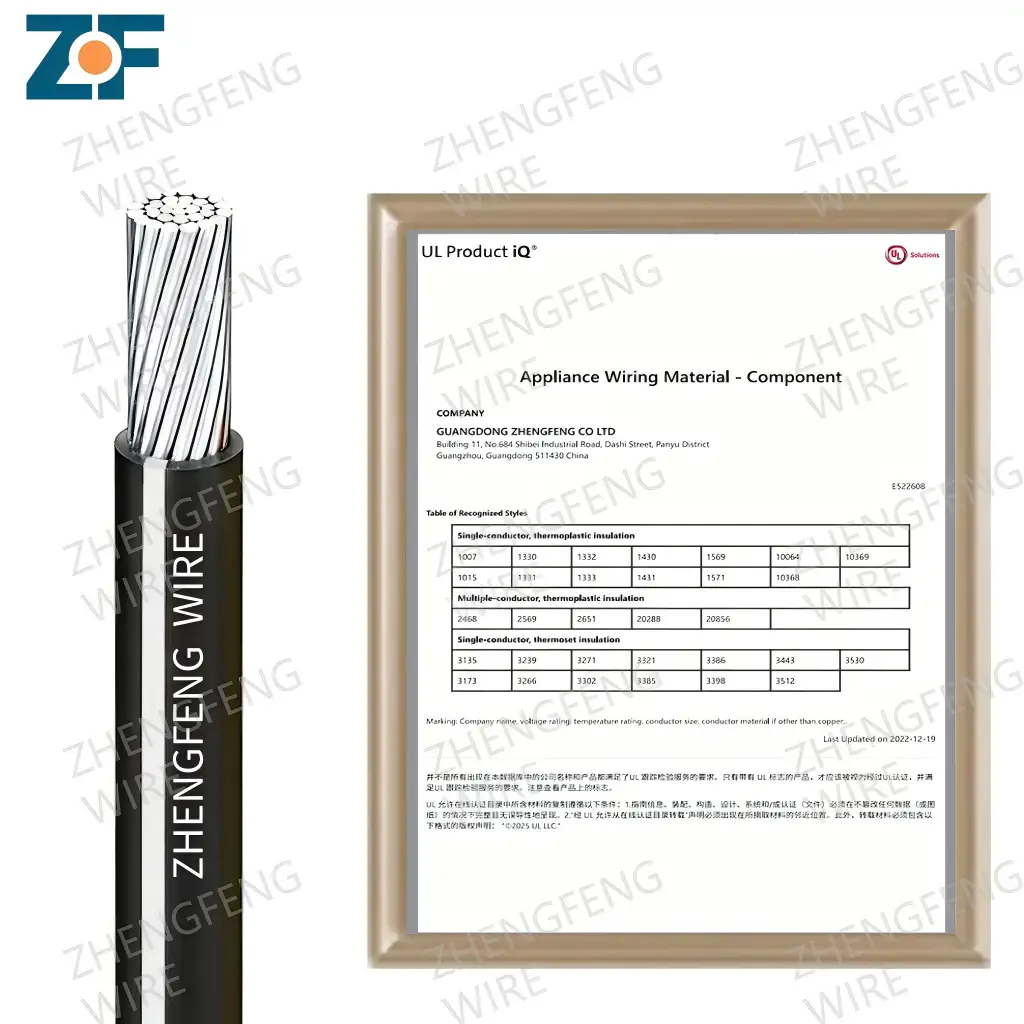
A reliable UL1015 supplier should be able to provide appropriate product specifications, conductor construction, insulation details, dimensional tolerances, temperature and voltage ratings, color options, test information, and applicable compliance documentation.
This is especially important for OEM production. Purchasing a wire only because its product title says “UL1015” is not enough. The complete construction should match the engineering drawing and the certification requirements of the final equipment.
UL1015 is often compared with UL1007, UL1569, UL1061, UL3173, and other hook-up wires. The correct choice depends on the electrical and environmental requirements of the application rather than simply selecting the wire with the highest numerical specification.
One of the most common comparisons is UL1015 vs. UL1007. UL1007 is commonly rated 300V and 80°C, while UL1015 is commonly rated 600V and 105°C. Therefore, when an equipment design requires a higher voltage rating or higher temperature rating, UL1015 may provide a more appropriate specification.
However, this does not mean UL1015 is always "better." If a small electronic circuit only requires a lower voltage and temperature rating, using a larger or more heavily insulated wire may add unnecessary cost and consume additional routing space.
UL1015 can also be compared with silicone-insulated wires. Silicone wire is generally selected when very high flexibility, high-temperature performance, or specialized environmental performance is required. If the application involves repeated movement, severe temperature fluctuations, or extremely soft wiring requirements, silicone insulation may provide advantages. On the other hand, for conventional internal wiring of electrical equipment, PVC-insulated UL1015 can offer a more economical and practical solution.
Another important distinction is between hook-up wire and complete cable assemblies. UL1015 is generally a single-conductor internal wiring product. It should not automatically be treated as a substitute for a multi-conductor cable, power cord, communication cable, or outdoor-rated cable.
This distinction matters during purchasing. If a customer asks for "600V cable," the engineering team should first determine whether the application actually requires a single-core hook-up wire, a multi-core cable, a shielded cable, a jacketed cable, or a finished cable assembly.
For manufacturers exporting to North America, the final product's certification requirements should also be considered. The wire is only one component of the overall electrical safety system. The finished equipment must comply with the standards applicable to that product category.
Therefore, the best approach is not simply to ask, "Is UL1015 the best wire?" Instead, ask:
Does UL1015 provide the required voltage, temperature, conductor size, flexibility, insulation, environmental resistance, certification, and manufacturing performance for this specific application?
If the answer is yes, UL1015 can be an excellent choice for internal equipment wiring.
UL1015 wire is mainly used for internal wiring in electrical and electronic equipment, control panels, industrial machinery, appliances, meters, power supplies, switchboards, and other equipment requiring appropriately rated internal hook-up wire.
Yes. Standard UL1015 is commonly specified with a 600V voltage rating. However, the actual allowable use depends on the wire's complete certification, construction, installation conditions, and the requirements of the finished equipment.
UL1015 is commonly rated at 105°C. This makes it suitable for many electrical equipment applications where the wiring may experience higher temperatures than standard 80°C hook-up wire.
Yes. Standard UL1015 construction typically uses PVC insulation around a copper conductor. The exact PVC formulation and insulation thickness can vary by manufacturer and product construction.
Yes. Tinned copper is a common conductor option for UL1015 wire. Depending on the supplier, bare copper may also be available. Tinned copper can be useful where improved oxidation resistance and termination characteristics are desired.
UL1015 is available in a broad range of AWG sizes. Commercial specifications commonly include sizes such as 30, 28, 26, 24, 22, 20, 18, 16, 14, 12, and 10 AWG, while some manufacturers offer larger sizes as well. Availability depends on the supplier and conductor construction.
Yes. Internal wiring of control panels is one of the common applications associated with UL1015 and other hook-up wires. Stranded UL1015 can be useful where wires need to be routed between terminal blocks, relays, circuit breakers, PLC components, power supplies, and other control devices.
8.Can UL1015 be used inside household appliances?
UL1015 is commonly used for internal wiring of appliances, provided that its electrical, thermal, mechanical, environmental, and certification requirements match the appliance design. The final appliance must also meet the applicable product safety standard.
The commonly cited difference is that UL1015 is rated 600V / 105°C, while UL1007 is commonly rated 300V / 80°C. UL1015 therefore provides a higher voltage and temperature rating, but the appropriate choice should always be based on the actual equipment requirements.
Compare conductor size, insulation material, temperature rating, flexibility, environmental resistance, certification, installation method, and the requirements of the final equipment. A wire with a higher nominal rating is not automatically the correct choice for every application.
Standard UL1015 is primarily intended for internal equipment wiring rather than highly demanding continuous-flex applications. If the wire will move continuously in robotic equipment, cable carriers, or repeated-motion machinery, a purpose-designed flexible cable should be evaluated.
Depending on the manufacturer, UL1015 can be supplied in different AWG sizes, conductor constructions, colors, insulation specifications, printing, packaging lengths, and other production configurations. OEM buyers should provide a detailed specification or engineering drawing so the supplier can confirm compatibility.
For an industrial or OEM project, buyers should request the product specification or datasheet, conductor construction, insulation information, rated voltage and temperature, dimensional data, applicable UL information, test requirements, and compliance documents such as RoHS or REACH when required by the project.
Provide the supplier with the equipment application, operating voltage, expected current, temperature range, required AWG size, conductor material, insulation requirements, environmental conditions, certification requirements, and annual purchasing volume. A qualified wire manufacturer can then recommend a suitable UL1015 construction instead of simply quoting a generic product.
The answer to "What is UL1015 wire used for?" is broader than simply saying "internal wiring."
UL1015 is a practical solution for manufacturers that need a 600V, 105°C hook-up wire for electrical equipment, control panels, appliances, industrial machinery, power supplies, meters, switchboards, and other internal wiring applications. Its PVC insulation, copper conductor options, broad AWG range, color availability, and established use in equipment wiring make it particularly suitable for OEM manufacturing and electrical assembly applications.
The international market also demonstrates the importance of this product category. China exported approximately US$31.36 billion of insulated wire, cable and other electric conductors under HS 8544 in 2024, with the United States accounting for approximately US$4.25 billion of China's exports within that broad category. In 2025, China remained the world's largest exporter of insulated wire and cable by reported export value, at approximately US$38.3 billion.
These figures do not represent UL1015 specifically, because customs classifications generally do not separate every UL wire style. However, they clearly demonstrate the scale of the global wire and cable supply chain and the continuing demand for reliable insulated conductors used throughout electrical and electronic equipment.
For engineers, the key is to select the correct AWG, conductor construction, insulation, temperature rating, voltage rating, and certification for the actual application. For procurement teams, the priority should be consistent quality, traceable specifications, stable production, certification documentation, and reliable delivery.
If you are developing control panels, power supplies, household appliances, industrial equipment, electrical assemblies, or other products for the North American market, UL1015 may be a suitable internal wiring solution.
For OEM and bulk projects, the most efficient approach is to provide your required AWG size, conductor material, color, voltage, temperature rating, packaging, annual quantity, and certification requirements to the wire manufacturer. The supplier can then confirm the appropriate UL1015 construction and provide samples and technical documentation before mass production.
Contact us
Guangdong Zhengfeng Wire&Cable Co., Ltd.
Tel/WhatsApp/Wechat: +86 13829292517
Tel/WhatsApp/Wechat: +86 14749307879
Email: manager01@wire-cablemanufacturer.com
Website: www.wire-cablemanufacturer.com


Products
Navigation
QR Code

Copyright © 2026 Guangdong Zhengfeng Wire&Cable Technology Co., Ltd.