 Zhengfeng
 Oct 27,2026

1.What Is Lay Length in a Stranded Wire?
2.How Is Lay Length Different from Lay Direction?
3.How Does Lay Length Affect Conductor Flexibility?
4.Why Can a Shorter Lay Length Increase Material Usage?
5.How Can Lay Length Affect Finished Conductor Diameter?
6.What Happens If Lay Length Is Inconsistent?
7.Is There One Ideal Lay Length for Every Wire?
8.How Do Manufacturers Control Lay Length During Production?
9.What Should Engineers Specify When Discussing Lay Length?
10.How Guangdong Zhengfeng Wire&Cable Co., Ltd. Approaches Wire Manufacturing Requirements
11.Frequently Asked Questions
When examining a stranded wire, buyers often focus on conductor size, strand count, and insulation material. However, another manufacturing parameter also affects the finished conductor: stranding lay length.
Lay length influences how individual strands are arranged around the conductor axis. Depending on the conductor construction, it can affect flexibility, conductor diameter, material usage, and production requirements.
Understanding this parameter helps engineers and wire buyers communicate more clearly with manufacturers, especially when a project requires consistent conductor construction or specific mechanical performance.
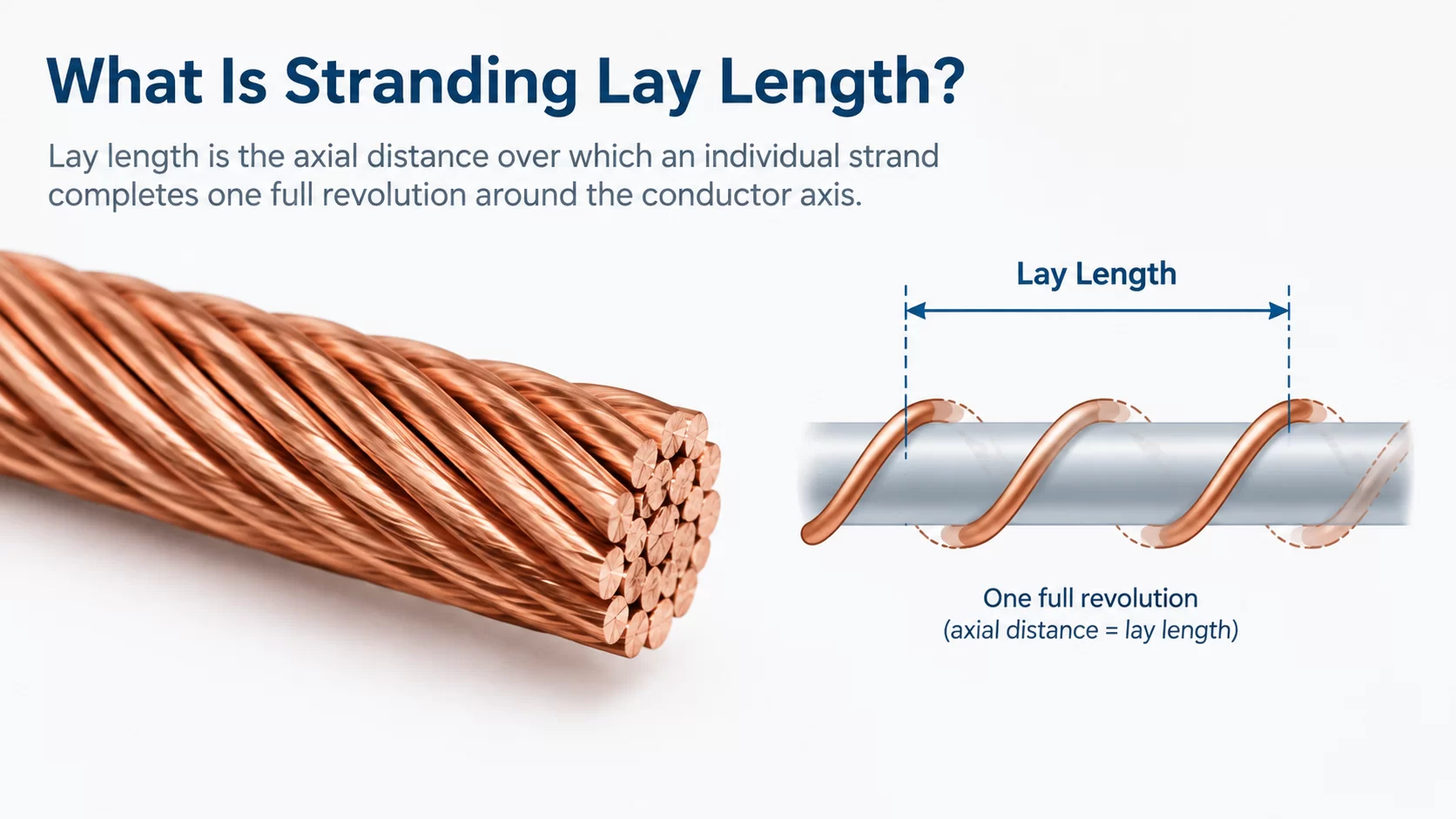
Lay length is the axial distance along a stranded conductor over which an individual strand completes one full revolution around the conductor axis.
In simple terms, imagine following one small copper strand as it twists around the other strands. The distance it travels along the length of the conductor before completing one full turn is the lay length.
A shorter lay length means the strand completes more turns over a given conductor length. A longer lay length means fewer turns over the same distance.
Lay length is not the same as strand count or conductor cross-sectional area. Two conductors with the same nominal size may have different stranding parameters depending on their construction and design requirements.
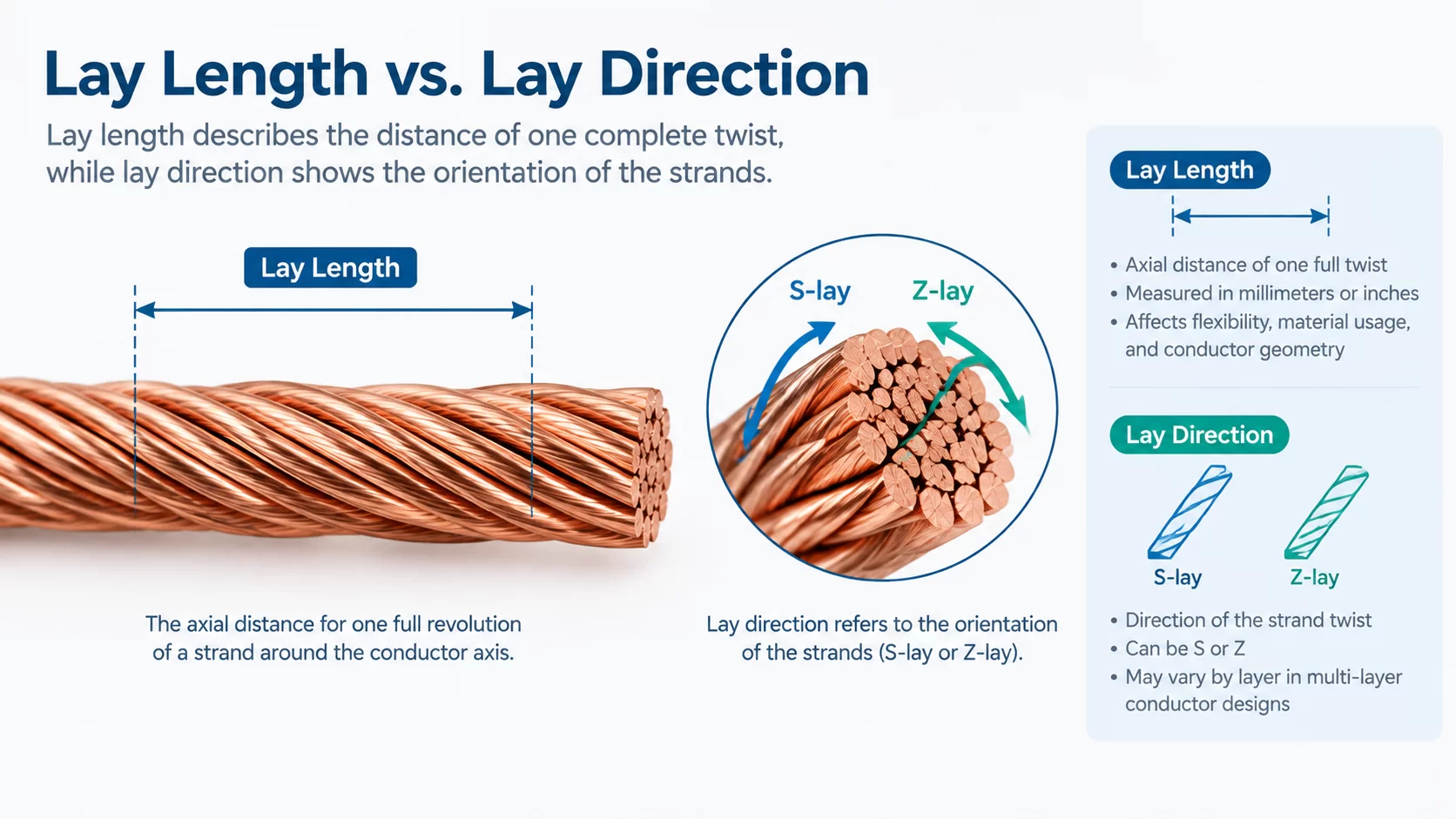
Lay length describes the distance of one complete twist, while lay direction describes the direction in which the strands are twisted.
The two commonly used lay directions are:
For multilayer conductors, different layers may have different lay directions and lay lengths, depending on the construction.
These parameters serve different purposes. Specifying the correct lay length does not automatically define the lay direction. When a project requires a particular construction, both may need to be considered.
Lay length is one factor that influences the mechanical behavior of a stranded conductor.
In many comparable stranded-conductor constructions, a shorter lay length can make the conductor more flexible because the individual strands follow a tighter helical path. However, the actual result also depends on strand count, individual strand diameter, conductor arrangement, and the intended application.
A longer lay length creates a more gradual helical path. This may be suitable for some conductor designs, but it does not automatically make the finished wire better or worse.
For example, a flexible internal connection wire and a conductor designed for a different mechanical duty may have different construction priorities.
The key point is that flexibility should be evaluated as part of the complete conductor design, rather than judged by lay length alone.For applications requiring flexible insulation, explore our flexible silicone wire product options to find a suitable solution for your wire assembly needs.
When a strand twists around the conductor axis, its actual path is longer than the conductor's axial length.
This means the individual strands may require more metal to produce a given length of finished stranded conductor.
For a simplified helical strand, the relationship can be expressed as:
[ L=\sqrt{P^2+(\pi D)^2} ]
Where:
For a comparable helical path diameter, reducing the lay length increases the strand's path length per unit of axial distance.
In manufacturing, this can contribute to increased conductor material usage and affect the cost of the finished product. The actual difference depends on the conductor's geometry and construction.
This is why changing lay length is not simply a matter of adjusting a machine setting. It can also have material and production implications.
Stranding brings individual wires together into a combined conductor. The arrangement and compactness of these strands influence the resulting conductor geometry.
Lay length can affect how strands sit against one another, but it is not the only factor determining finished conductor diameter.
Other important factors include:
For insulated wire, conductor geometry also matters because the insulation process must accommodate the conductor's actual dimensions. A manufacturer needs to consider the complete construction rather than adjusting one parameter in isolation.
Consistency matters when a product requires a defined conductor construction.
If lay length varies beyond the applicable production requirements, the conductor may not maintain the intended geometry or mechanical characteristics. The significance of the variation depends on the product specification and the application.
Potential concerns include differences in flexibility, changes in conductor geometry, and inconsistency between production batches.
However, not every small variation indicates a defective product. Acceptance should be determined against the applicable specification, approved construction, and relevant test requirements.
For manufacturers, process control helps maintain repeatability. For buyers, clearly documented construction requirements make it easier to verify that delivered products match the agreed specification.
No. There is no single lay length that is ideal for every stranded conductor.
Different designs have different priorities. A conductor intended for flexible connections may require different characteristics from one designed for another mechanical or electrical duty.
Applicable product standards may also specify permitted lay-length ranges or construction requirements. These requirements should take precedence over general rules of thumb.
For this reason, manufacturers should consider the conductor size, strand construction, intended application, and relevant specifications when determining suitable production parameters.
A shorter lay length should not automatically be interpreted as higher quality, just as a longer lay length should not automatically be interpreted as lower quality.
The correct value is the one that satisfies the requirements of the particular conductor design.
Lay length is established through the stranding process and depends on factors such as equipment configuration, rotational speed, and the rate at which the conductor advances.
Manufacturers need to use appropriate process settings for the specified conductor construction and maintain those settings throughout production.
Depending on the product and its inspection plan, verification may involve checking the stranded construction, measuring lay length, and reviewing other relevant conductor characteristics.
It is also important to distinguish between controlling a machine parameter and verifying the finished product. A production setting alone does not demonstrate that every requirement has been met.
Consistent manufacturing therefore involves both appropriate process control and suitable inspection against the product specification.
When lay length is important to an application, engineers and buyers should avoid relying on vague descriptions such as "tight stranding" or "high flexibility."
A useful technical discussion may include:
Conductor size: The nominal AWG or cross-sectional area.
Strand construction: The number and diameter of individual strands, where specified.
Lay length: The required value or permitted range, if defined by the applicable specification.
Lay direction: S-lay, Z-lay, or another requirement where relevant.
Performance requirements: Flexibility, mechanical duty, or other application-specific needs.
Applicable standards: The relevant product standard or approved construction requirements.
Not every project needs a customer-defined lay length. For standard products, the manufacturer may already have an established construction that meets the applicable requirements.
The important step is to clarify whether lay length is a controlled requirement for the project or a manufacturing parameter managed within the approved design.
At Guangdong Zhengfeng Wire&Cable Co., Ltd., conductor construction is one of the factors to consider when manufacturing insulated wires for different applications.
The appropriate construction depends on the product specification, conductor requirements, and intended use. Parameters such as strand count, individual strand diameter, and stranding arrangement need to be considered together rather than treated as independent choices.
Our product range includes silicone rubber wires and cables, FEP-insulated wires, PVC wires, and XLPE wires for different electrical and industrial applications.
For buyers developing a new wire specification or reviewing an existing construction, providing clear technical requirements helps establish whether a standard construction is suitable or further engineering discussion is needed.
If your project has specific conductor construction requirements, our team can discuss the relevant specifications and product options with you.


Products
Navigation
QR Code


Copyright © 2026 Guangdong Zhengfeng Wire&Cable Technology Co., Ltd.